 WALKSCAPE
 Crosswave Edition
Rie Utagokoro and the Years Before She Found a Wider Audience
2026-09-01
The Singer Many Listeners Discovered at 50
For Korean listeners who discovered Rie Utagokoro (歌心りえ), 2024 is probably the year that comes to mind. MBN’s Korea–Japan singing competition brought her to Korean television audiences. Appearances on its Korea–Japan Top Ten Show followed, and her decision to sing Japanese songs in Japanese made an impression. Videos of her performing ‘Yuki no Hana’ (雪の華) and ‘Dōkeshi no Sonetto’ (道化師のソネット) drew a strong response online. In Korea, she came to be seen as a Japanese singer whose wider recognition began there.
The Rie Utagokoro who emerges from her memoir, whose Korean title translates as I’ll Always Sing of Love, has a much longer history. She made her professional debut in 1995 as the vocalist of the trio Letit go. Its second single, ‘200-bai no Yume’ (200倍の夢), was used in a Pocari Sweat commercial. She later formed Ciao with her older sister, worked independently under the name Rie, and in 2004 formed September, a trio of piano, voice and cello.
When that first debut fell short of her hopes, she kept singing. The names, collaborators and forms her work took changed, but music stayed in her life. A career begun in her twenties carried her through her thirties and forties. By the time more people began to know the name Rie Utagokoro, she was nearing 50.
In 2023, at 50, she entered the audition show Trot Girls Japan. It meant returning to the position of a contestant and being judged after years of working as a singer. She finished second. Her appearance on MBN’s Korea–Japan singing competition in 2024 made her better known in Korea, and she made her solo major-label debut at 51, releasing SONGS and HEARTS in April 2025.
Almost 30 years had passed since her first debut.
Reduced to a résumé, her story fits into a sentence: a singer endured 30 years of obscurity and found success after 50. Profiles often use phrases such as ‘30 years in obscurity,’ ‘a challenge at 50’ and ‘late success.’ After reading the book, it becomes harder to call the preceding 30 years a time when she simply failed to succeed.
Does a Late Breakthrough Make the Earlier Years a Failure?
Look at a life backward from the outcome and the years leading up to it can seem surprisingly simple. Everything after the breakthrough becomes a period of success, and everything before it becomes a period of waiting to succeed. Viewed that way, Utagokoro’s life becomes the story of a dramatic reversal around her fiftieth birthday.
But she did not suddenly learn to sing when she entered Trot Girls Japan in 2023. She did not acquire her expressiveness when Korean audiences began listening in 2024. A major-label solo debut at 51 did not make her a singer for the first time. Rie had been singing long before a large audience found her.
The depth people hear in her singing is difficult to separate from those earlier years. She worked in different forms, went through periods that did not bring the results she hoped for, and found other ways to continue. Time accumulates in a voice. What moved listeners in Korea was likely the sound of someone who had spent decades making music.
Reading I’ll Always Sing of Love, I found it difficult to see 50 as the start of her success. It felt closer to the moment when people began to discover a singer who had already spent a long time getting ready.
I would hesitate to reduce that to a promise that hard work always pays off. Sometimes people work as hard as they can and the outcome they want still does not come. Doing something for a long time does not guarantee the world will recognize it. It can be just as misleading to look backward from Rie’s success and decide that everything before it had to happen in order for her to get there.
There are things that become possible because you have kept at them. You cannot choose when an opportunity comes. The years beforehand can determine what you are able to do when it arrives.
When Trot Girls Japan came along, Rie had already spent decades performing and refining her voice. That was the singer who could stand on another stage at 50 and show an audience what she could do.
That is where her story stays with me, somewhere away from the easy promise that effort inevitably leads to success.
Effort cannot guarantee success. What you build during years when nothing much seems to be happening can still help you take hold of a chance when it comes.

When Continuing to Sing Was Hard
Calling the years before her breakthrough three decades of steady work also misses part of the story. There were times when she had to ask whether she could keep singing at all.
Rie developed vocal fold nodules twice. The second time she lost her voice and had to communicate in writing. For a singer, the voice is the means of continuing the work they have spent their life doing. Once it fails, the prospect of singing in front of people again can be frightening.
She recalled worrying that her voice might disappear again on stage. While helping at the restaurant with live music that her husband ran in Shimokitazawa, she watched other musicians perform at close range and wondered whether she needed to sing anymore.
This part stayed with me. We know what happened next: she sang again, entered an audition at 50 and found listeners in Korea. At the time, Rie knew none of it. There was no reason to believe that returning to singing would produce a different outcome.
She had already worked in music for years without gaining the recognition she wanted, and now she had to deal with a vocal injury. It is easy to write that she refused to give up. Living through those years would have been another matter.
This is also where the book becomes harder to read simply as the story of one person succeeding through determination.
Getting Through It With Someone Beside You
The person closest to Rie when she pulled away from singing was her husband. The memoir explains that they did not start as spouses or musical collaborators. A guitarist himself, he was a fan of her music first. He told her how he felt three times. She turned him down twice, then sensed his sincerity the third time. The relationship between a singer and a fan became a romance, then a marriage.
It was not always easy. When Rie struggled with an unfavorable contract, her husband blamed himself and wondered whether she might have avoided it if he had been more capable. He even considered divorce, thinking she might be better off with someone else beside her. What stays with me is his sense of helplessness at seeing someone he loved struggle and being able to do so little. Rie was asking what to do about her music. He was asking what he could be for her.
He was also there when the vocal injury drew her away from singing. He ran the music restaurant in Shimokitazawa, and she helped out and watched other musicians perform. She had lost enough confidence to wonder whether there was any reason to sing when good musicians were already there making people happy. Stepping in front of an audience again after years of mixed results and a vocal injury could hardly have been easy.
It was her husband who brought up singing again. In an interview about that time, Rie recalled him asking when she would sing again and reminding her that she still had her songs. She decided to face her own singing again. With the outcome known, it can sound like a brief conversation. It takes on a different weight if you remember how they met. The person who once loved her singing as a fan was still the person who believed in it when she had begun to doubt its value.
Rie still had to recover, practice and get back on stage herself. She chose to enter Trot Girls Japan at 50 and sing in front of an audience again. Her husband could stand close and encourage her, but he could not sing or audition for her. The decision and the work were hers.
It is hard to endure years on willpower alone, especially once you doubt what you can do. Someone close to you can remember possibilities you have forgotten and believe there is still time to act on them. That can make the next step possible. Rie and her husband did not solve one another’s problems. Each had doubts and moments of helplessness. They still went through important parts of their lives together.
I came away thinking about the person who shared those years as much as I thought about the singer who held on to a dream for 30 years. He was first a fan, then the person she shared her life with, and then someone who still believed in her singing when she questioned it herself. The work of pursuing a dream remains yours. You can have company along the way.
The Years That Shaped the Voice We Hear Now
Experiences that looked like setbacks at the time can still be heard in Rie’s voice today. Before the injury, she had felt that her technique demanded too much force. Afterward, she looked for a gentler way to sing. She recorded herself, listened repeatedly and adjusted her technique.
That was the voice so many people noticed in Korea. It would be unfair to romanticize the injury as something she needed to go through in order to succeed. It was a difficult period and might genuinely have ended her career. The experience does show how hard it is to tell where a setback might lead while you are living through it.
The same applies to the years after her first debut fell short of expectations. From a distance, Letit go, Ciao, Rie and September can look like a series of attempts that never produced one major breakthrough. The person who had been through all of them stood on another audition stage at 50 and finished second.
She went to Korea and sang Japanese songs that moved Korean television audiences. The response to a singer who had worked in Japan for years traveled back there, and in 2025 she made her solo major-label debut at 51. Thirty years is a long time to wait for wider recognition. It is also a long time to build the voice and judgment that let her make that opportunity her own.
Were those earlier years a failure? After finishing the book, I found that difficult to believe.
At 50, the Story Continued
People often describe Utagokoro as someone who ‘took on a challenge at 50.’ She did enter an audition at that age and go on to a new period of recognition. Reading her memoir puts a different emphasis on the phrase.
Singing was something she started in her twenties and carried through her thirties, forties and into her fifties. The audience found her later. Calling it a miracle at 50 loses too much of what happened before. What came after reads like the next chapter in a long story.
It also changes the way I think about age. It is easy to decide that there is an age beyond which it is too late to begin, or that an opportunity is gone if the result you hoped for has not appeared by then. In music, where youth is often treated as an advantage in its own right, that feeling can be especially strong.
Rie chose to be judged on another stage at 50 and made her solo major-label debut at 51. She went on her first nationwide tour in 2025, and SONGS and HEARTS received a Japan Record Award for planning. She continued with new albums and touring in 2026.
Her career gives us reason to be slower about deciding what someone can still do based on their age.
What Helps Someone Keep Going?
Before I read I’ll Always Sing of Love, I thought of Rie Utagokoro as a singer who spent a long time out of the spotlight and found her opportunity in Korea. That alone was an interesting story. What stayed with me afterward was elsewhere.
I kept thinking about how she lived through the years when success was anything but certain. In her twenties, Rie did not know that people in Korea would notice her after 50. When an injury made her afraid to sing, she could not know her voice would one day move people in another country. Somehow, her connection to singing remained.
The saying that heaven does not abandon people who work hard is tempting to apply here. I would be careful with it. People can work for years and never get the result they hoped for. Treating success as a reward that inevitably comes can flatten the very years that make Rie’s story interesting.
Even without knowing what will happen, the time you spend on something you care about can accumulate. When an unexpected opening appears, some of what you built in those years can help you do something with it.
There is another question: who was beside you while you were getting through those years?
What It Means to Witness Someone’s Dream
That may be why I kept thinking about her husband after I closed the book. It is easy to applaud someone once things are going well. Staying when there are no visible results, or when the person themselves doubts what they can do, can be harder.
The person cheering you on cannot live your life. You still have to decide whether to keep hold of the dream, and you are the one who has to get back up. There are limits to what anyone around you can do. Those limits may be what give their presence meaning.
They can walk beside you. They can believe your dream still has a future. And during the years when nothing seems to come of the work, they can remind you that what you have done already matters. That is one way to stand behind someone for a long time.
It means remembering what someone is capable of even when things are difficult, and being there when they choose to move again. If they finally get where they had hoped to go, you can remember the years it took as well as celebrate the outcome.
I was left with two questions after reading about Rie. Were the years before a late breakthrough a failure? Can anyone bring a dream to life entirely alone?
Rie’s life makes it hard to say yes to the first question. The years before 50 helped shape the voice and the ability to make the most of an opportunity when it finally came.
The second question is just as difficult. You have to live your life and do the work yourself. Someone who believes in you can still help you carry on longer than you might have managed on your own.
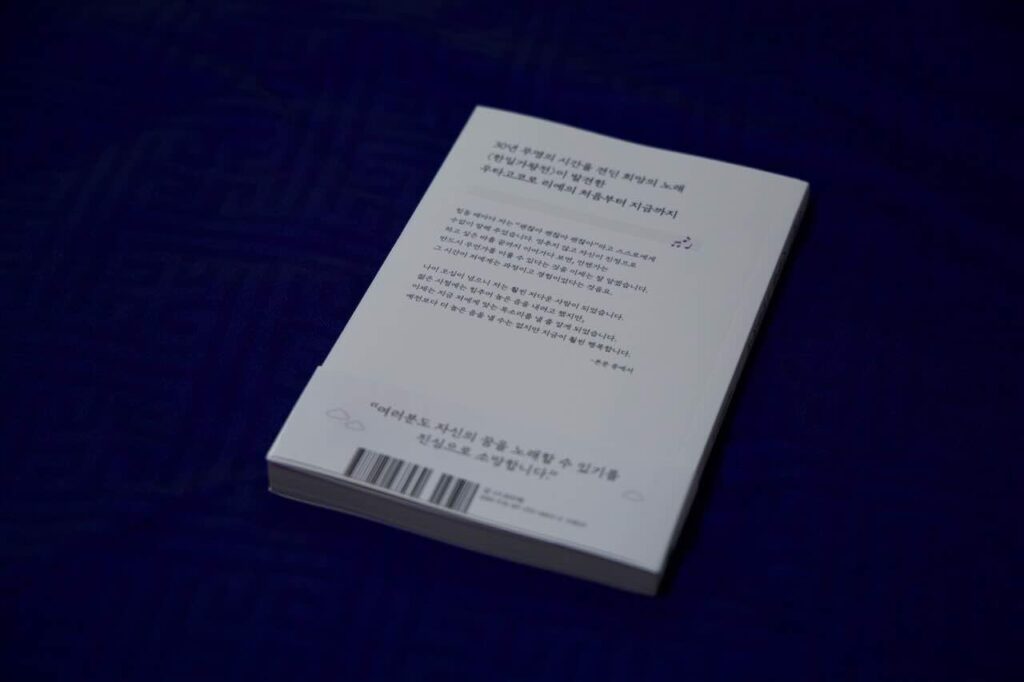
I’ll Always Sing of Love stayed with me as a book about the years when nothing seems to come of the work, and about the people who spend those years beside someone and keep watching over a dream.
The Rie Utagokoro we hear now did not appear suddenly at 50. The stages, expectations, disappointments and new attempts that began in 1995 all contributed, along with the people who walked beside her.
What stays with us may have less to do with when the dream came true than with what she kept doing on the way there, and who walked those years with her.