 WALKSCAPE
 Crosswave Edition
What does an apostille certify on a graduation certificate?
2026-11-16
A university overseas asks for a graduation certificate with an apostille. Your Korean university can issue the certificate in English. Do you still need a translation? Should you visit a notary? Will an apostille make the university recognise the degree? The questions come from the same document, but each has a different answer.
Start with the language the university accepts
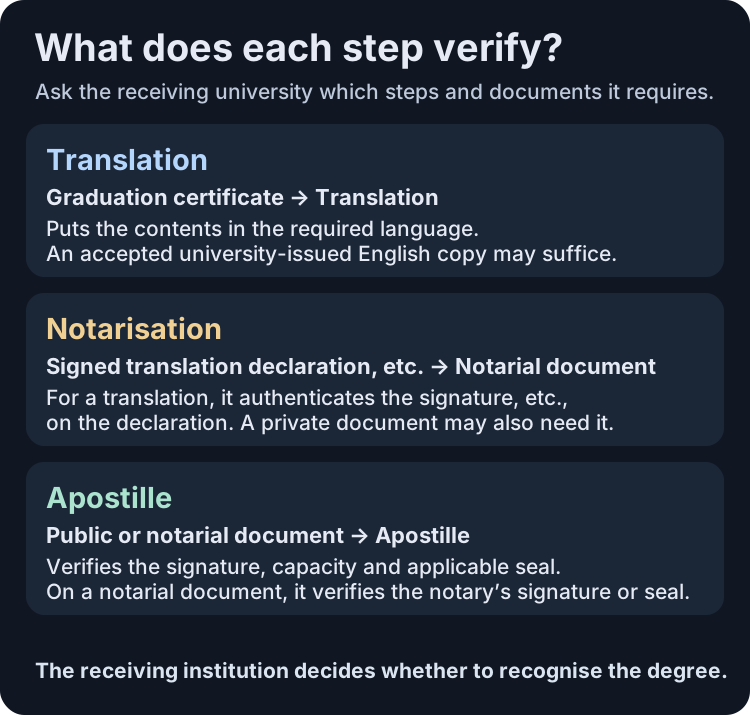
A translation lets the receiving institution read the document in the language it requires. If it accepts an English certificate issued directly by your Korean university, a separate translation of the Korean certificate may be unnecessary. If it asks for a translation into its own language or requires a designated translator, the English certificate may not meet that requirement.
Check the format separately. A certificate issued on paper, a scan of that certificate and an electronic certificate from the issuing university may contain the same words. An admissions office can still have different rules for each.
What the notary certifies
In Korean practice, notarising a translation can involve authenticating a signed declaration that the translation corresponds to the original. The process records which document was translated and who made that declaration. It serves a different purpose from evaluating a degree.
Notarisation can also be required for reasons unrelated to language. Korean consular guidance gives certificates issued by private universities as an example of documents that can go through notarisation before an apostille is issued for the notarial document. Obtaining an English certificate does not in itself remove that requirement. If the receiving institution asks for apostilles on both the original and a translation, check the route for each document.
An apostille certifies the document’s origin
An apostille verifies the signature, the capacity in which the signatory acted and, where applicable, the seal or stamp. When it is issued for a notarial document, the signature or seal it authenticates is the notary’s. That is why it matters which document the receiving university wants apostilled.
The admissions office still decides whether your degree meets its entry requirements. Where the Apostille Convention applies between the two countries, the competent authority in the place where the document originated issues the apostille in place of traditional consular legalisation. The HCCH status table is a starting point for checking whether that route applies.
What to ask the admissions office first
Ask whether it accepts a university-issued English graduation certificate. Then ask which document needs an apostille: the certificate, the translation or both. Check whether it accepts an electronic file or requires a sealed paper copy or direct delivery from the issuing university. Once you know exactly what it will accept, look up the route for that document on Korea’s apostille portal.
Official sources
Korean apostille portal
Korean consular guidance
Korean notarisation forms rules
HCCH convention overview and status
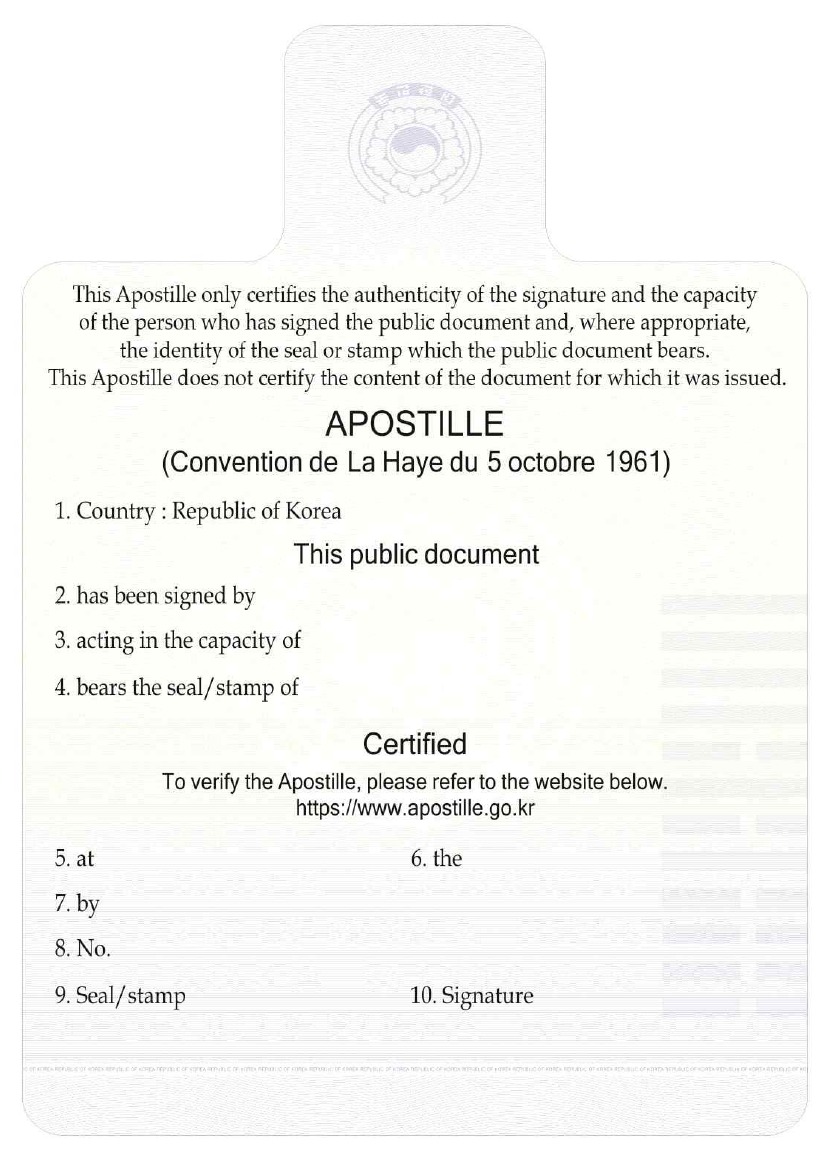
Cover image · Korean apostille specimen (Korea Law Information Center, Form 2)