 WALKSCAPE
 Crosswave Edition
Why Koreans “Eat a Year” with Their New Year’s Soup
2026-02-16
The first bowl of the year
Seollal morning follows a familiar rhythm. After preparing late into the previous night, everyone gets up early. The family holds its ancestral rites, bows to its elders and sits down to eat. Then the rice cake soup arrives, and someone asks, “How many bowls of tteokguk have you had?”
Today the question usually gets a laugh. The joke comes from a custom in which a bowl of tteokguk marks the start of the year. Eating it gives the change in the calendar a moment everyone at the table can recognize.
In Korea’s traditional age reckoning, a child was one at birth and everyone gained a year at the New Year. It was a change people went through together, regardless of when their birthdays fell. The soup gave that shared change a place at the family table.
A bowl on Seollal morning was a way of stepping into the year with everyone else.
Why rice cakes?
The rice cakes carry much of the meaning. Making tteok from rice once took ingredients and work that households were more likely to set aside for an occasion. A bowl filled with sliced rice cake made the morning feel different from an ordinary breakfast.
Tteok still appears at many Korean celebrations and rites that mark a beginning.
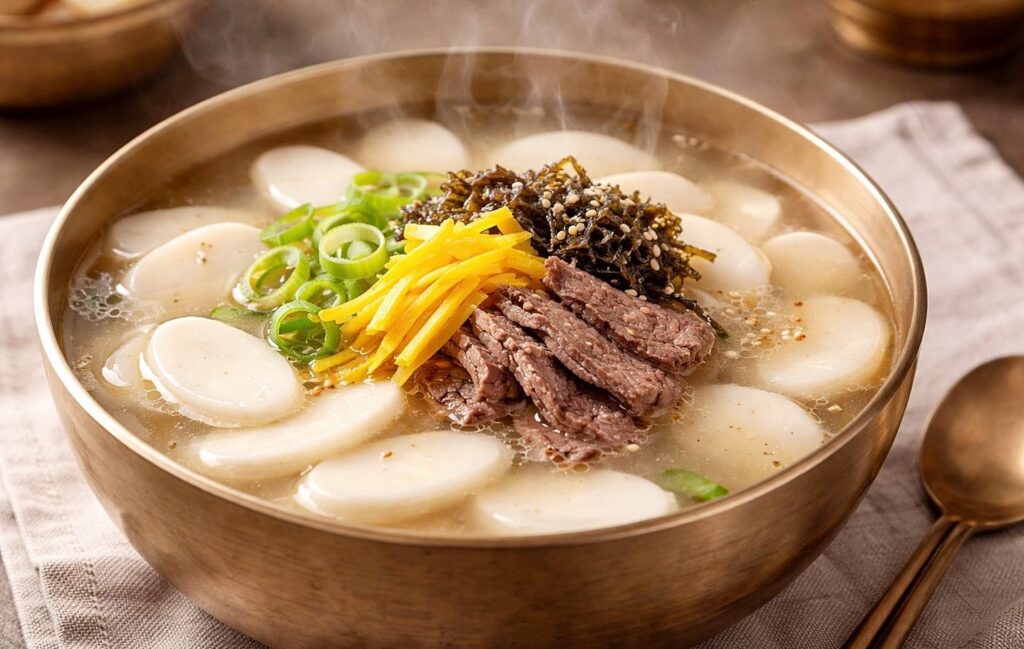
Garaetteok, the kind used for this soup, is formed into long cylinders. The length is associated with a long life. Sliced crosswise, the cakes resemble old coins, a wish for good fortune in the coming year.
The same rice cake can express both wishes, first in the length of the roll and then in the shape of the slices.
What it means to “eat a year”
In Korean, one ordinary way to say that someone is growing older is nai-reul meokda, literally “to eat age.”
At Seollal, a bowl of soup makes the expression feel wonderfully literal.
The joke works because the traditional calendar put the change on the same day for everybody. Children and elders gained a year together. The moment was especially easy for a child to grasp when an older relative pointed to a bowl and asked how many years they planned to eat.
The soup gave an otherwise invisible change something you could see and taste.
The adults who made sure the children had some were inviting them to take part in a custom they had once learned the same way.
Why the morning matters
Seollal morning is when the custom is most closely associated with the family meal.
It is both the first morning of the year and the first meal of the day. The family can mark the change together while the rest of the year is still ahead of them.
The ancestral rite brings earlier generations into the morning. Over the soup, the people gathered around the table share the year beginning now. Miss the bowl and the morning can feel unfinished, even if you have eaten plenty.
A date everyone shares
A birthday is still an occasion of its own. Seollal marks a different passage, one that belongs to everybody at once.
Age carries particular weight in Korean terms of address and in the way younger and older people speak to one another. Traditional reckoning gives everyone a common date on which to move forward a year, while each birthday remains a private milestone.
The soup brings that collective idea of age into an ordinary gesture, passing a bowl across the table.
Why the custom endures
Age in everyday and official settings is now often expressed in completed years. The soup has stayed on the table even as the arithmetic has changed.
A family that rarely eats together might sit down to tteokguk once a year. By the time everyone has a bowl in front of them, the meal itself is already doing much of what the custom has always done.
So when someone asks how many years you’ve eaten, there is still something to the joke. You are being asked about the year you just began in their company.
The bowl says that the new year has begun and that everyone at the table has entered it together.