 WALKSCAPE
 Crosswave Edition
Harry’s Grand Slam — Nine Innings with Three Cards in Hand
2026-02-06
Board-game night usually took place at Dive Dice in Daehangno. We knew the tables and were getting to know the games. Maybe that was why I wanted to try somewhere else. Did we really need a board-game café? For this extra session we took a game to Ramen Party, a small shop near a side gate of Sungkyunkwan University. And this time, the owner joined the table too.
I wanted to give the baseball-loving owner a baseball game and play it with him. The one I brought was 〈Harry’s Grand Slam〉, a remarkably old game known in Korean as “Harry’s Grand Slam.”
A Card Game from 1962
The game dates all the way back to 1962. Its designer, Harry Obst, emigrated from Germany to the United States and worked as an interpreter. According to the story, he fell hard for Major League Baseball the first time he saw it. The game grew out of that enthusiasm. It feels like the great-grandparent of the baseball games we play today.
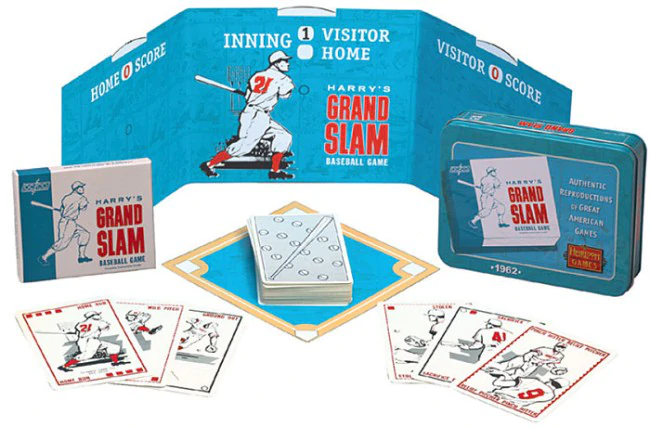
I opened the box and wondered whether it could possibly be fun. Inside were a few cards, a diamond-shaped board and a scoreboard you turned by hand. By today’s standards it looked bare and old-fashioned. Once we spread it out on the table, I began to see why people still talk about it.
Simple Rules, a Game That Feels Like Baseball
Each player starts with three cards. You take turns batting and fielding, playing one card at a time. There are offensive cards for singles, doubles and home runs, and defensive cards for strikeouts, fly balls and grounders. After playing a card, draw another to refill your hand. Keep going for nine innings and you’re done.
On paper it looks like a game of luck, and what you draw does matter. At the table it feels like more than that. A hand full of hit cards gets your hopes up when you’re batting. A string of outs comes as a real relief when you’re fielding. A handful of cards starts to feel like a miniature contest between pitcher and batter.
The Scoreboard Creates the Tension
We began as casually as if it were an exhibition game. The away side batted first, and we turned the scoreboard after each run. Things looked bad from the first inning. Our pitcher was getting knocked around, and by the bottom of the third the score was already 7:1. At that point I thought we would finish the game just to see how it worked.
Then it got interesting. Inning by inning, we pulled closer. Every card started to feel important. In the bottom of the eighth, it was 8:9. We had gone ahead, and the mood changed. The game had begun with laughs. Now people were taking their time over the cards they put down.
Then came the bottom of the ninth. When the last turn at bat was over, the score was 9:11. We had come back to win. I never expected a baseball card game to produce a game like that.
A Small Twist from the Bullpen and the Bench
The game also has special cards: Relief Pitcher and Pinch Hitter . Draw a card secretly, lay it face down and cover it with the special card. Reveal it when you think the moment is right. It feels like sending in a reliever or calling a pinch hitter.
It’s a small rule, but it gives you a reason to ask whether to play your card now or save it. That decision keeps the tension going to the end.
The Feel of an Old Rulebook
After the game, I opened the instructions again. The paper and illustrations felt like they came straight out of 1962. There was a way to play with three people. Two would play while the third kept score, and the loser would keep score in the next game. It was a generous interpretation of a three-player variant.
I liked that bit of roughness. It gave me a glimpse of the time the game came from and how people enjoyed baseball then.
A Simple Game That Stays with You
There is little deep strategy here. All the same, one play is enough to remember it. A few cards create the rhythm of nine innings, and a scoreboard raises the stakes. At the end, you find yourself saying it was more fun than you expected.
It made a good extra outing for board-game night. With someone who loves baseball, you have something to talk about as soon as you open the box.
The fact that someone made a game like this in 1962 is a good story on its own.
Game Information
Harry’s Grand Slam
- Players
- 2 (a variant uses a third player as scorekeeper)
- Playing time
- About 20–30 minutes
- Genre
- Sports / Card game / Luck-driven
- What to expect
- Baseball played with cards, inning-by-inning scoring and a surprisingly tense game