 WALKSCAPE
 Crosswave Edition
How Does Generative AI Learn? A Short Course, Explained
2025-12-28
What Google Cloud’s introductory course covers
Generative AI moved quickly into ordinary work after the arrival of products such as ChatGPT. For many people it changed how a first draft, an illustration or a piece of code could begin.
Technology companies are building generative models into products people use every day. That can make it hard to tell a basic change in how software works from a claim about what one new feature will do.
A better starting point is a question that applies across products.
“How does a system learn to generate something it has never been asked for before?”
An introduction built around four questions
One place to begin is Google Cloud’s Introduction to Generative AI on Coursera.
The current course page lists about 24 minutes of video and estimates about an hour with the other work. Its job is to give a broad explanation for beginners before the mathematics or implementation.
The course has four main questions.
- What is generative AI?
- How does it work?
- What kinds of generative models are there?
- What can people use them for?
What a generative model can make
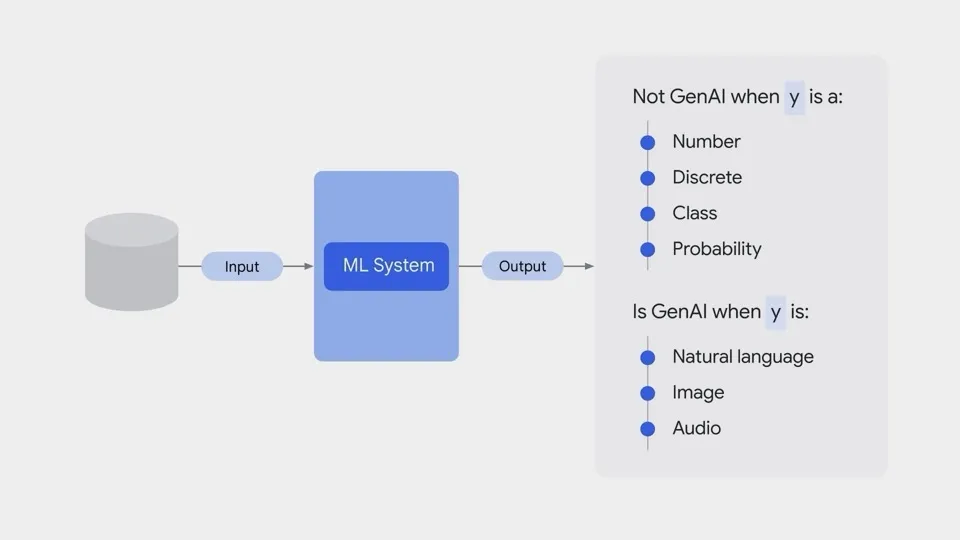
The course defines the field by the kinds of output a system can produce.
Generative systems can produce text, images, audio, video or synthetic data in response to suitable inputs.
A model that identifies spam or forecasts demand may output a category or a number. A generative system can build a longer output piece by piece, such as a paragraph of text or an image. Large language models are an important example, alongside other kinds of generative models.
AI, machine learning and deep learning
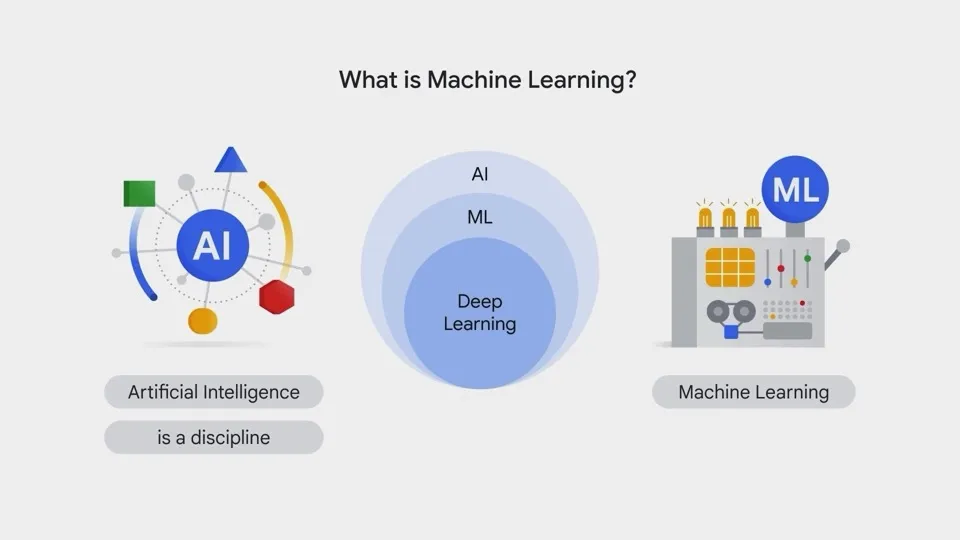
It starts by separating three terms that are often used interchangeably.
A useful way to see the relationship is AI → machine learning → deep learning.
- Artificial intelligence (AI): a broad term for systems that carry out tasks associated with intelligence.
- Machine learning: methods that learn patterns from data rather than relying only on rules someone wrote for every case.
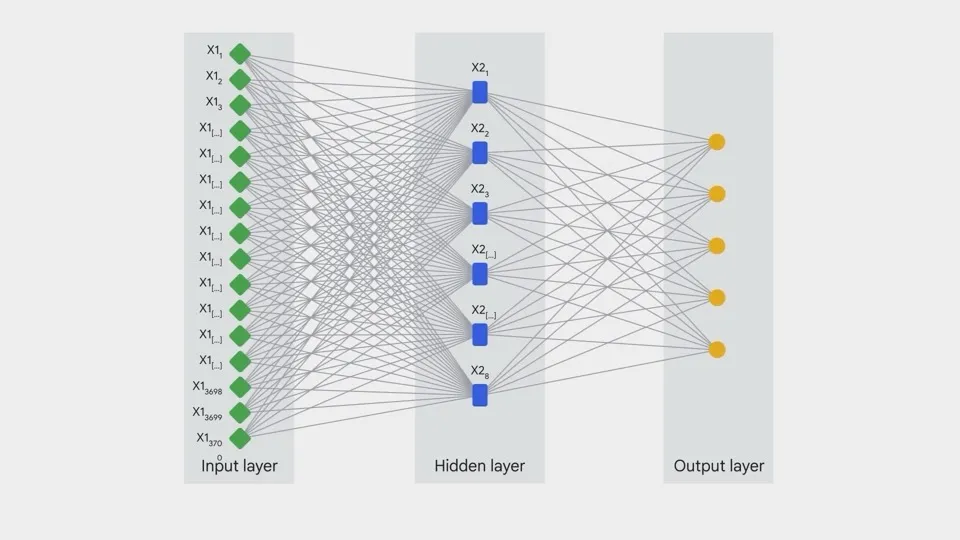
- Deep learning: machine learning that uses neural networks with many layers to represent complex patterns.
Training can use labeled examples, structure derived from data, or feedback from actions. Much of today’s generative AI uses deep learning with one or more of those approaches.
Supervised and unsupervised learning
Where the training signal comes from
Models learn patterns from data. What differs is the kind of information they receive during training. The label, target or feedback guides what the model gets better at.
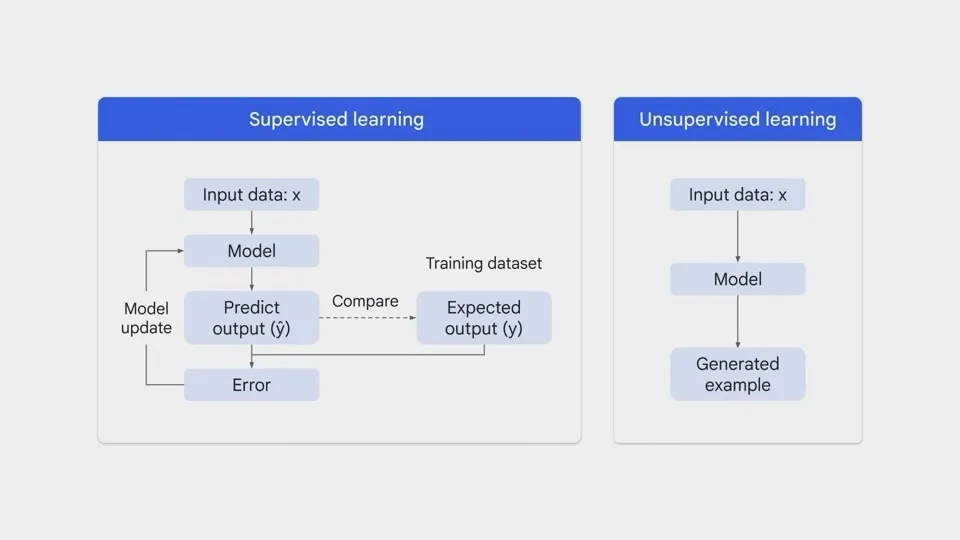
Supervised learning
In supervised learning, the training data contains examples with target outputs. A label could identify an object, flag a message as spam or give a numerical value the model should learn to predict.
Given enough examples, the model learns a relationship it can use on new input.
This input goes with this output. At training time the model can compare its prediction with the target and adjust. At inference time it uses what it learned on a new example.
That describes familiar tasks.
- Examples of spam and legitimate email → a spam filter
- Sale prices and information such as size and location → a home-price estimate
- Labeled images of cats and dogs → an image classifier
Typical tasks are classification, choosing a category, and regression, estimating a numerical value. Obtaining reliable labels can take time and money. Good accuracy still depends on the quality and coverage of the examples.
Unsupervised learning
Here the data comes without the target labels used for supervised training. The model looks for structure in the data itself, such as recurring patterns or groups.
Typical questions concern the structure of the data.
- Does the data contain groups?
- Which features do similar examples have in common?
- What looks unusual relative to the rest?
Possible uses include the following.
- Clustering records according to shared characteristics
- Grouping customers by purchase patterns
- Looking for unusual transactions or activity in a network
The technique can reveal relationships people had not thought to label. Deciding what those relationships mean and whether they are useful takes separate work.
Why the distinction helps
Think about where the model’s training target comes from before asking what it has learned.
- Supervised methods fit cases where the desired answer can be supplied for training examples.
- Unsupervised methods can help when the structure you want to discover has not yet been labeled.
Language models are often pretrained with self-supervised learning, using targets drawn from the text itself, such as predicting the next token. Later stages can use human-written examples or feedback to shape the way a model responds.
Generative and discriminative models
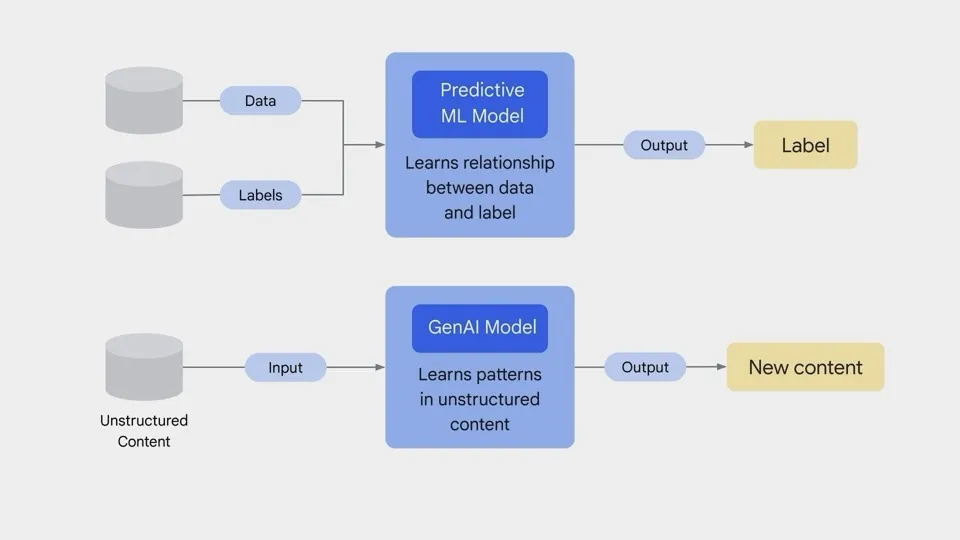
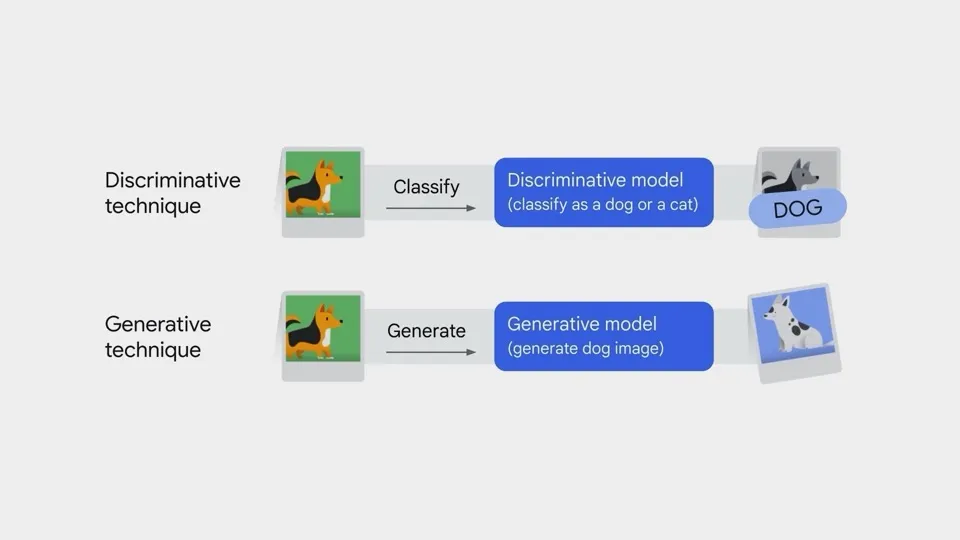
The course also distinguishes between models that make a judgment about an input and models that can produce a new example.
- A discriminative model can learn to classify an email as spam or an image as showing a cat.
- A generative model can produce text, an image or synthetic speech, depending on how it was trained and used.
The short version is that a discriminative model learns a way to separate or predict outcomes for a given input, while a generative model learns patterns or distributions it can sample from to produce something new.
The transformer in language models
Many modern language models build on the transformer, introduced in 2017. The original paper described an architecture using attention to relate tokens to one another.
The original model had an encoder and a decoder for sequence-to-sequence tasks. Many text generators instead use a decoder-only architecture. Training can process many positions together, while generation generally produces one new token after another.
A model may give a plausible answer containing an invented or incorrect claim. This is often called hallucination. Generating a likely sequence of words gives the model no automatic guarantee that a claim is true. Check important facts against a source you can inspect.
Prompts, outputs and tools
When a model generates an answer, you can influence the result with the input you give it.
The prompt may include a question, the material you want the model to use, examples of the desired format and constraints on the result. People call the practice of working out how to present those instructions prompt engineering.
The course surveys some common uses.
- Text → text
- Text → image
- Text → video or 3D content, with a model designed for it
- Text → an action or task, where the system has access to suitable tools
A foundation model is trained broadly enough to be adapted or used for multiple tasks. The product people use can add tools, retrieval and interface rules on top of that model.
Google’s tools in the course
The last part of the course introduces tools from Google Cloud.
The course introduces Vertex AI and Model Garden as Google Cloud’s offering at the time, with a catalog of models that developers can use or adapt. Names and specific offerings change, so the documentation is the better place to check what is available today.
PaLM API and MakerSuite belong to an earlier generation of Google’s developer tools. Google AI Studio and the Gemini API are better reference points for current examples. Capabilities vary by Gemini model, so check the documentation for the input and output formats you need.
What you can take from a short course
The course gives a compact introduction to what the systems can do, where people use them and how the major ideas fit together.
It is a useful place to begin if you keep hearing the names of these systems and want to know what the parts do. It also gives you language for what you see the next time a model predicts a label, makes a draft or gets a detail wrong.
I would use it to get clear on the distinction between learning from examples and producing a response before going on to a longer course or trying a model yourself.
Course information
Introduction to Generative AI
- Topics
- Computer science and artificial intelligence
OWL Magazine may earn a commission if you make a purchase through an affiliate link in this article.