 WALKSCAPE
 Crosswave Edition
Yu Darvish’s 99-mph Ricochet
2026-01-01
The pitch and everything that happened after it
A baseball game can produce a play that seems unlikely to happen quite the same way again. When Yu Darvish’s fastball hit Lewis Brinson and caught two more people on the rebound, it was one of those plays. The pitch became a small story about what baseball fans do with an accident the moment a replay becomes available.
You can tell it by following the ball. Once it leaves the pitcher’s hand, nobody quite knows where it will stop.
A baseball borrowing from billiards
Three-cushion billiards takes its name from the way the cue ball must use the cushions before completing the carom. Baseball offers few occasions to borrow the term. For a pitch that is already a dead ball, this one kept finding things to hit.
The game was April 15, 2019, at Marlins Park. Chicago won 7–2. The next day, MLB’s coverage lingered on a hit-by-pitch from the bottom of the sixth.
One pitch, three people
April 15, 2019, in Miami
The batter in the sixth was Lewis Brinson. Darvish had walked four that night, but he still had close to 99 mph on the pitch that ended his outing.
Darvish’s final pitch of the night was a two-seam fastball clocked at 98.7 mph. It hit Brinson and caromed behind the plate, catching home-plate umpire Brian O’Nora and Cubs catcher Willson Contreras.
Batter, umpire, catcher.
One ball, three people, in less time than it takes to say their names.
The replay lets you pick out contacts that barely register at game speed. The noise on the clip gives the sequence almost as much rhythm as the picture.
Why the replay looked familiar to StarCraft fans
Three different ways to name a bounce
Once the clip circulated, people reached for metaphors from anywhere they could find them. A billiards player could see a carom. MLB’s own clip described it as pinball. There was a gaming comparison, too.
The Mutalisk.
In StarCraft, the Mutalisk’s attack can bounce from its target to nearby units. Watch the baseball change direction behind the plate and the resemblance is easy to see.
It helped that Darvish was already a pitcher people liked to watch closely. A delivery fans normally paused to identify by grip or movement turned up in their feeds for an entirely different reason.
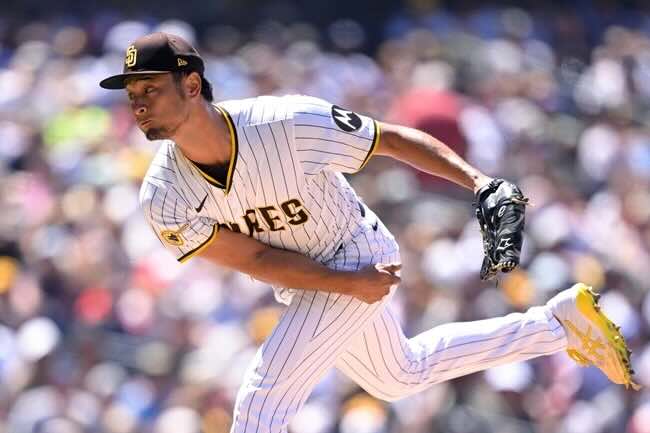
Why it mattered that it was Darvish
A pitcher people watch pitch by pitch
I have seen plenty of strange bounces. What makes this one stick is that it begins with someone whose pitch design and command can sustain a whole conversation of their own.
Darvish has a deep repertoire and puts thought into what each pitch can do. In this game he had brought his two-seamer back into heavier use. The movement of the ball after it reached Brinson was something nobody could have designed.
The clip is a reminder that a pitcher can control a great deal of what happens on the way to the plate. Once the ball strikes something, the geometry belongs to the game.
What the replay can keep
Baseball’s official record is precise about the event that mattered. Brinson was hit by a pitch. The official video has room for the path the ball took afterward.
That extra room is part of the pleasure of watching highlights. A broadcast can keep a moment even if it made little difference to the score. The next time it turns up, everyone can see a slightly different version of the same joke.
The pitch had a measured velocity and a name. The ricochet had both of those things available as raw material for a story.
The part you remember
A hit-by-pitch is an ordinary line in a box score. You might read it once and go on to the next at-bat. This one is the sort people remember because they can still see the ball bouncing.
It is an account of a throw that belongs as much to the catcher, the umpire and the batter as it does to the pitcher.
Even Darvish would have a hard time doing it a second time.