 WALKSCAPE
 Crosswave Edition
Fenway Park’s Green Monster and the Baseball an Uneven Field Makes Possible
2025-12-31
There are plenty of ways into major-league history. One of the most direct is to look at where the teams play and what the ground asks of them.
A major-league ballpark can tell you something about the city that built it. A fence follows a street. Seats wrap around an awkward corner. A parcel that made sense to a developer leaves a problem for the left fielder a century later.
Set the parks out on a map and you can read a history of American cities alongside a history of the sport.
Boston’s Fenway Park is the clearest place to start.
The shape Fenway had to fit
Fenway opened in 1912 and is the oldest active major-league ballpark. Its sightlines vary considerably by seat. Some of its concourses are narrow, and its outfield dimensions refuse to line up neatly from one side to the other.
The building took shape on a particular piece of land. What looks strange on a diagram starts to make sense once you see what the club and the architect had to fit around it.
The Red Sox built the park by Lansdowne and Ipswich streets. The city block gave the outfield its boundaries. Later generations found new ways to use that same outline.
The wall in left sits 310 feet from the plate down the line. The right-field line is actually shorter at 302 feet, but with a much lower fence, while the gaps and deep center stretch the field in other directions. Compare the heights as well as the distances and it becomes clear how differently the corners play.
That unevenness gives a visitor something to learn. A deep fly and a low line drive can trade places in their value when one of them reaches a high wall set close to home plate.
The high wall is the Green Monster. A fly that clears a lower wall elsewhere may hit its face here, leaving a live ball for the fielder.
The ball asks different things of the batter and the left fielder. The batter can benefit from a hard shot off the wall. A fielder can take some of that value back by knowing where it is likely to come off and getting it back to the infield quickly.
The essential shape survived several renovations. The field is still close enough to its neighborhood to make you think about the streets whenever a ball goes out over left.
Fenway gives one particularly visible example of how a set of rules can leave room for a park to acquire its own character.
For a player, reading that character is part of the work. For a spectator, it is part of what makes the same lineup and same rules produce a different game here.
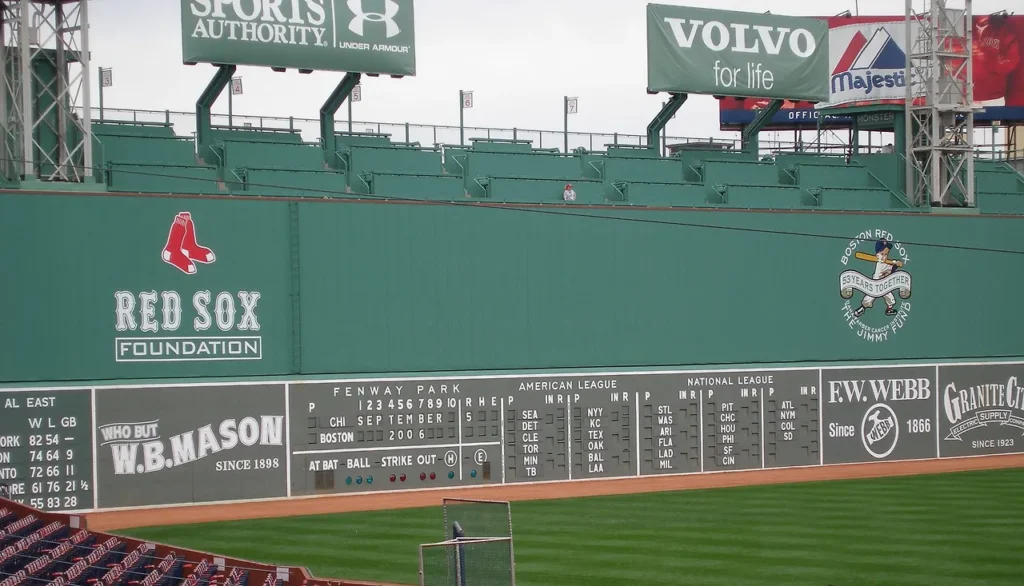
How the Monster took its present shape
The wall is a little over 37 feet tall, roughly 11.3 meters. In a photo it is easy to see the color first. In person, the height is what makes you understand why the name stuck.
It was not originally green. For years it carried advertising. Those signs came down and the wall was painted green for the 1947 season.
The earliest version was a roughly 25-foot wooden fence. Red Sox owner John I. Taylor wanted to prevent people on nearby rooftops and in upper-floor windows from watching without a ticket.
The present form took shape in a 1934 rebuild after a fire, with a concrete base and a manual scoreboard. A net added later caught balls headed for businesses on Lansdowne Street. Seats replaced the net in 2003, and the old ladder used to retrieve balls remained.
Each change solved a problem the club had at the time. Together they left an outfield feature players still have to prepare for.
A wall both high and close
A tall fence makes the ball travel higher to clear it. At Fenway, the distance from home plate also brings the wall within reach of a well-struck ball that may have been a routine fly somewhere else.
The left-field wall is close enough to reach and high enough to change the reward.
The flight of the ball, how much carry it still has when it reaches the wall and where it strikes the surface all affect what follows.
A fair ball that goes over the line on top is a home run. A ball that strikes the face and comes straight back is generally playable. Its value then depends on the bounce and what the runner and fielder do with it. Fenway’s ground rules also cover unusual cases, such as a ball that hits the ladder and bounds out.
Left fielders have to anticipate the angle, the height and the speed of the rebound. Sometimes the best move is to give the ball room to come back to them.
For the pitcher, a mistake can become extra bases even if the ball stays in the park. For the batter, a line drive that reaches the wall may do enough. Neither outcome is settled until someone plays the rebound.
Calling Fenway a hitter’s park describes part of its reputation. The part you can watch on an ordinary play is how well both teams adapt to the surface the ball is about to hit.
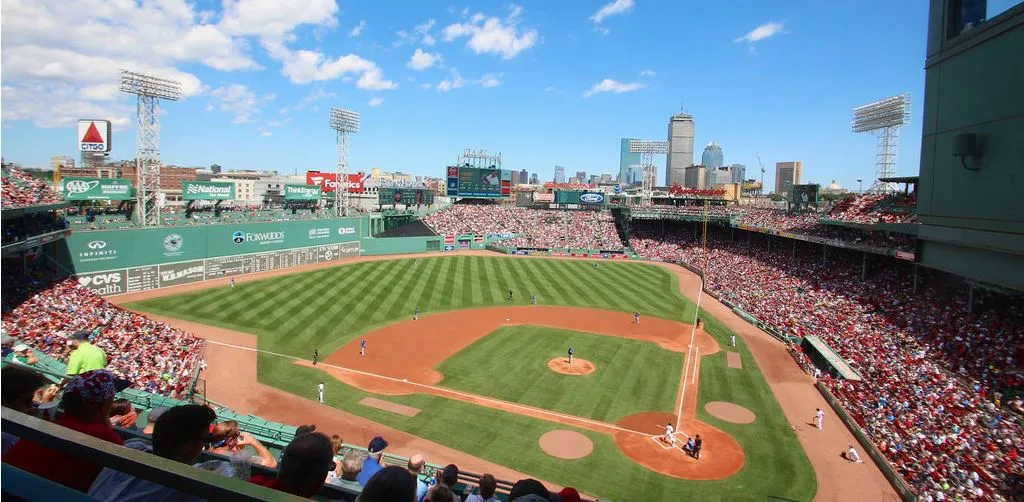
Why the asymmetry is still there
Plenty of newer parks offer wider circulation, more consistent sightlines or a roof. Fenway still asks spectators to deal with a building shaped by earlier priorities.
It also gives the Red Sox and their visitors a left field they have to learn. The wall earns its place every time a fielder judges a hop against it.
Major League Baseball leaves room for individual parks to write ground rules around features the standard rules cannot describe. Fenway needs such language because some of its corners, lines and surfaces are unique to Fenway.
Every club gets the same opportunity to learn the wall when it comes to Boston. The home club has more days in which to do it.
What started as a boundary became a piece of the game. The wall still carries the manual scoreboard, the green paint, the ladder and all the ways players have learned to send a ball back in from its base.
The dimensions tell you where the ball is going. The next few seconds are what tell you where you are.
At Fenway you can see the relation between a city block and the game played inside it simply by watching a ball come back off the wall.
There will be another one the next time Boston plays at home.