 WALKSCAPE
 Crosswave Edition
Blah Blah Blah — Dan Roam on What to Draw When Words Stop Helping
2024-04-02
An idea can be good and still go nowhere if nobody else can see what you see in it. Getting the idea into a form someone can respond to is part of getting the work done.
I remember the spread of presentation interviews in Korea in the 2010s. A presentation could seem like an odd extra hurdle in a job interview. It also made clear how much people expected a candidate to do with an idea in front of a room.
Making an Idea Easier to Share
Dan Roam’s Blah Blah Blah: What to Do When Words Don’t Work gives drawings a part in that work. Words may be the quickest way to name something, while a picture can make it easier to see how the parts relate.
Steve Jobs’s presentations helped popularise the sparse, image-led slide. Text still has a job to do, especially when an audience needs precise details. The form can follow what people need from the material.
Roam proposes a way of using the two together. He calls it Vivid Thinking.
Thinking with Words and Pictures
He starts with a criticism of how people learn to explain things. In many settings, a written account signals seriousness while a rough sketch looks like something a child would make.
He turns to Dr. Seuss, whose The Cat in the Hat and Green Eggs and Ham use deliberately limited vocabularies alongside pictures. The illustrations give readers information and timing the words would have to work harder to supply alone.
Vivid Thinking
Roam’s fox stands for verbal thinking, and his hummingbird for visual thinking. Each notices something the other can miss.
His term VIVID combines the visual and verbal as interdependent parts of making sense of an idea.
- VIVID : Visual + Verbal InterDependent
A Grammar for Drawing an Idea
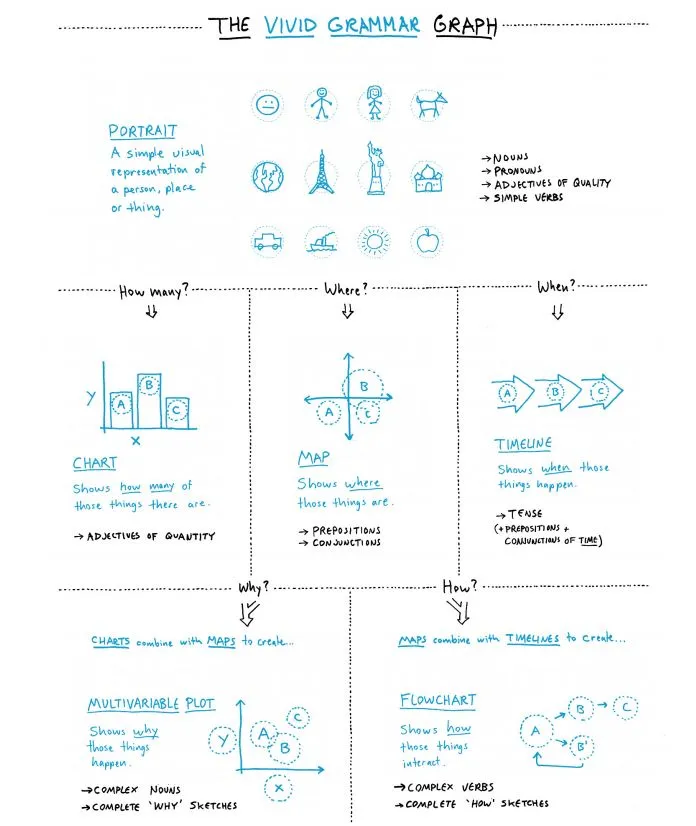
Roam suggests six visual forms. You can choose among them as you would choose the kind of sentence a point calls for.
- Portrait — who or what the idea is about
- Chart — how much or how many
- Map — where things are in relation to one another
- Timeline — when something happens
- Flowchart — how something works or what happens next
- Multivariable plot — why several factors might produce a result
What Makes an Idea Vivid? FOREST
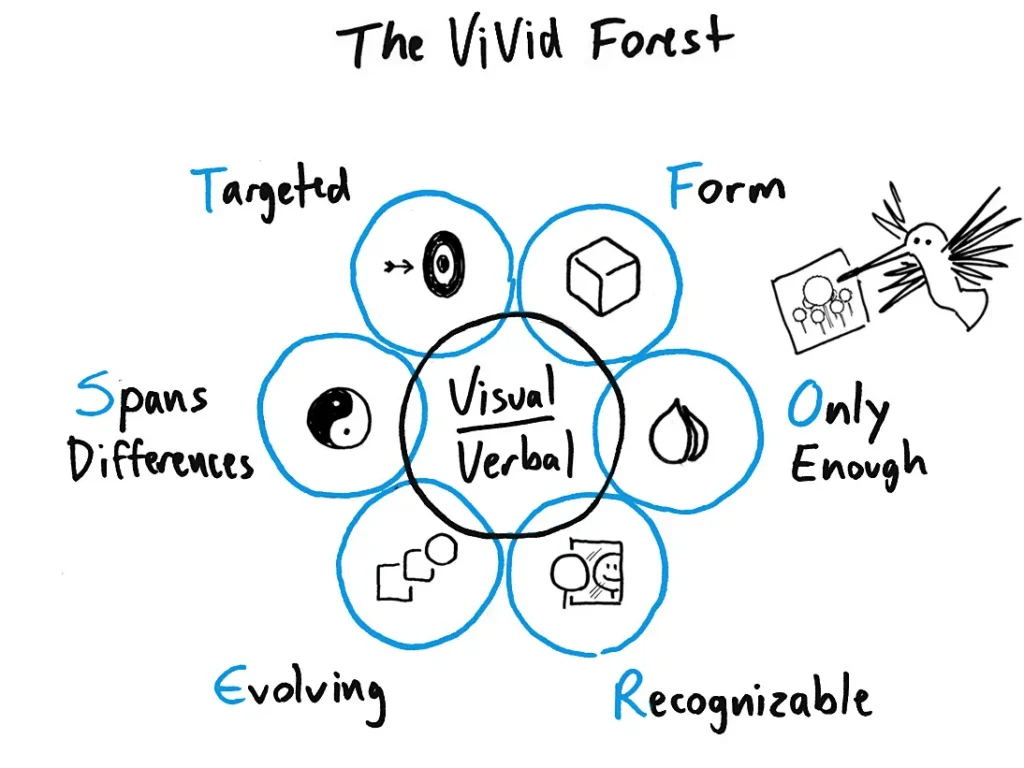
Roam uses FOREST as a way of remembering six qualities of an idea people can grasp and carry forward.
- Form — give it a shape.
- Only the Essentials — leave the core visible.
- Recognisable — give the audience something they can identify.
- Evolving — allow it to develop.
- Span Differences — make room for differences and opposites.
- Targeted — know whom you need to reach.
Form
A cloud with a recognisable outline stays in the mind more easily than a patch of haze. A useful shape can give a thought something similar to hold on to.
Only the Essentials
Make the idea small enough to sketch on a napkin. Supporting detail can come later, once the audience has a way to place it.
The book connects this to the BLUF principle, “bottom line up front”: put the conclusion where the reader can find it first.
Recognisable
The familiar pyramid associated with Abraham Maslow’s hierarchy of needs gives the theory a shape that many people can recall.
Maslow did not draw that pyramid himself. The later image shows what can happen when another person gives a set of ideas a memorable form.
A title can work in a similar way. A metaphor may give a reader a better first hold on a business book than a generic description.
Evolving
Roam wants an idea to leave some room for the next person to work on it. An early sketch of a device, such as Leonardo da Vinci’s drawing of a parachute, can be looked at again long after the conditions that produced it have changed.
A useful drawing can be complete enough to share and open enough to be developed.
Span Differences
Try placing the idea next to something very different from it. Looking for the opposite can reveal an assumption that was hard to see from inside the original proposal.
Targeted
What an audience already knows and what it needs to do are part of the design of a presentation.
Roam offers an audience check he calls LESH. The questions concern who will hear the idea and how they are likely to use it.
- L — leadership: do they decide or carry out the work?
- E — expertise: are they specialists or new to the subject?
- H — how much weight will they give to numbers and other quantitative material?
- S — support: are they receptive or opposed?
How to Notice When a Talk Has Lost Its Point
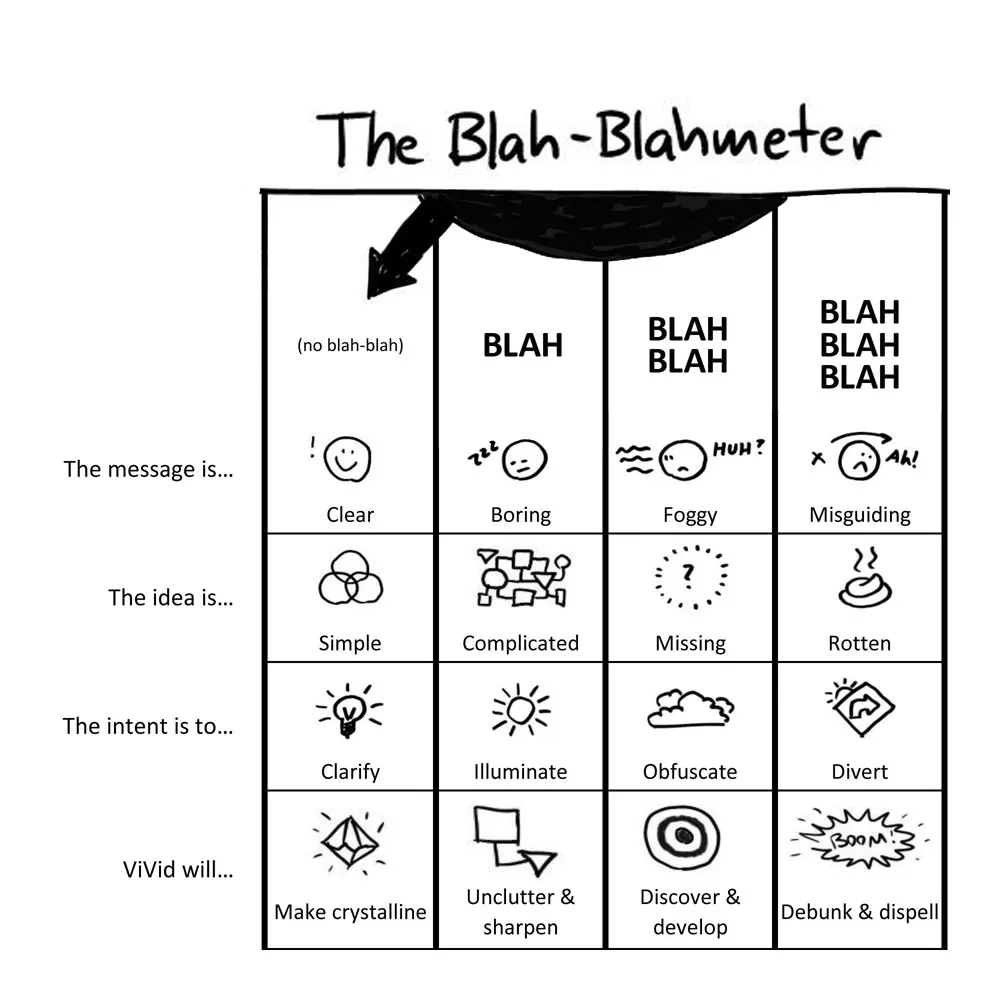
Roam’s “Blah-Blahmeter” sorts different ways words can get in the way of a thought.
- If there is no interference, leave the explanation alone.
- If it is dull, organise it.
- If it is vague, find the idea and develop it.
- If it is misleading, expose what is obscuring the point and remove it.
Ways to Try Vivid Thinking Soon
- Start with the Vivid checklist.
- Use the Blah-Blahmeter.
- Choose one form from the visual grammar.
- FOREST
- Work backwards through your own explanation to see what it assumes.
- Make a character map for a book, report or presentation.
- Draw a picture of what the meeting is about before it starts.
Ways to Make It a Habit
- Practise thinking with words and pictures together.
- Give people a clear image they can pass on.
- Make somebody responsible for simplicity.
Words and Pictures in the Same Explanation
Using visual material in a presentation is familiar now. The hard part is deciding what belongs in a picture and what would be better to say.
Roam’s grammar gives you a way to start. If the question is about sequence, draw a timeline. If it is about process, try showing what follows what.
The book is worth opening when you know your material and still need to see what another person could make of it.
Book Information
Blah Blah Blah: What to Do When Words Don’t Work
- Author
- Dan Roam
- Publication
- 17 September 2012 (Korean edition)
- ISBN13
- 9788901149516
We may earn a commission on purchases made through the affiliate link in this article.