 WALKSCAPE
 Crosswave Edition
Camping beside 2,000 Years of History — Snow Peak Opens at Yoshinogari
2026-10-23
Snow Peak opened an outdoor complex at Yoshinogari Historical Park in Saga Prefecture on March 18, 2026. Lodgings modelled on Yayoi-era watchtowers and pit dwellings share the site with a campground and shops devoted to Saga’s craft and food.
Daily Life in Ancient Japan at Yoshinogari Historical Park
Saga lies next to Fukuoka in northwestern Kyushu. It is known for hot springs, ceramics, natural scenery and food. Arita and Karatsu are major pottery centres, Ureshino is known for its hot springs, and Saga beef and Yobuko squid are among the prefecture’s specialities. From Fukuoka, Saga is within reach for a day trip or an overnight stay. In the east of the prefecture, Yoshinogari and Kanzaki offer a chance to see both the landscape and traces of ancient Japan.
Yoshinogari Historical Park spans the two municipalities and was built around one of Japan’s major Yayoi-period archaeological sites. The Yayoi period, commonly dated from the eighth century BCE to the third century CE, saw the spread of rice cultivation and the growth of settled communities across the Japanese archipelago. Yoshinogari preserves traces of a large settlement that flourished around the second and third centuries CE. The site helps archaeologists understand both the spaces people occupied and the society that developed around them.
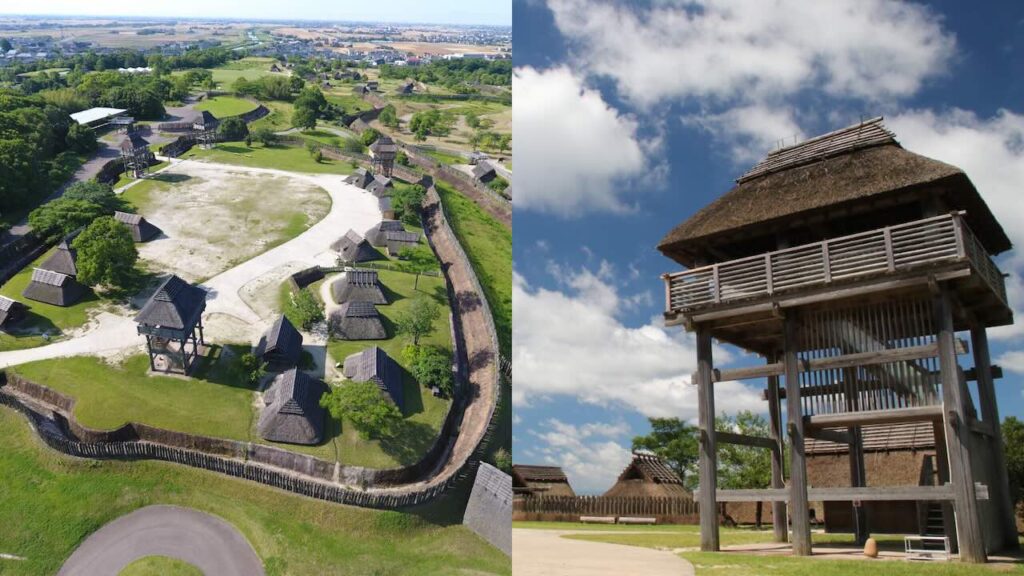
Covering about 106.9 hectares, the park reconstructs a Yayoi settlement from archaeological findings. Visitors can see the defensive moats, watchtowers, pit dwellings and raised storehouses that would have held food. Walking between the buildings gives a sense of the settlement’s scale and layout. There are workshops in fire-making and crafting magatama, the curved beads associated with ancient Japan. Broad lawns, play areas and seasonal events also make it a place for a family outing.
On March 18, Snow Peak added camping, accommodation, shops and places to eat with the opening of Snow Peak GROUNDS YOSHINOGARI. The Japanese outdoor company’s new complex gives visitors a place to stay among the scenery after touring the archaeological site. It serves day visitors as well as people who want to spend the night and explore the area at a slower pace.
Lodgings Inspired by Yayoi Watchtowers and Pit Dwellings
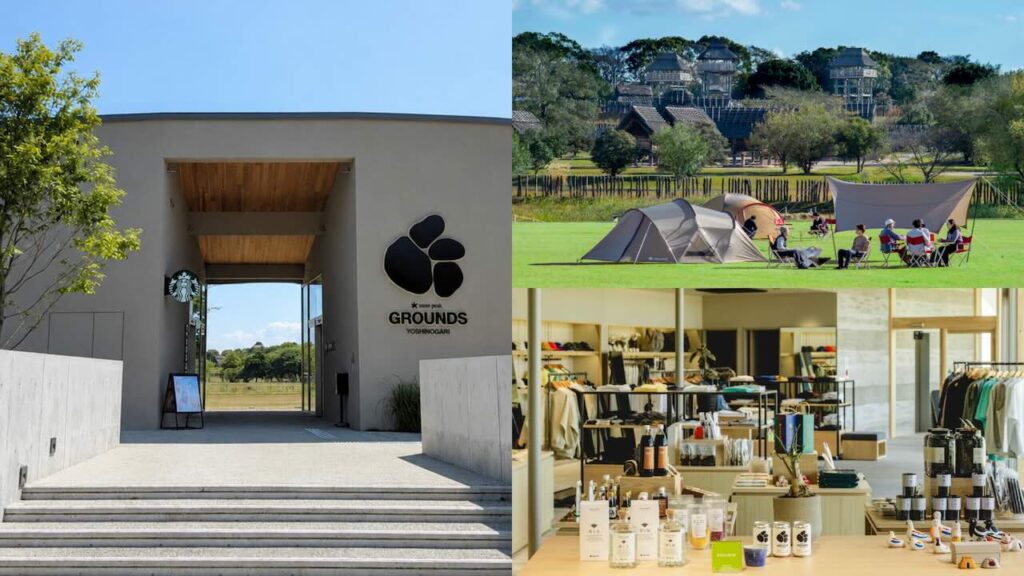
The complex is divided into a retail and dining area, with Snow Peak’s own shop, cafés and a restaurant, and a lodging area with campsites, cottages and cabins. The campground looks towards the Yoshinogari ruins and the Sefuri Mountains. There is space to pitch a tent and spend time outdoors, with the surroundings of a historical park giving the campsite a character of its own.
Rental packages are available for anyone who cannot bring equipment. You can rent a set of camping essentials, which is useful if you are new to camping or flying to Japan and have no easy way to carry a tent, sleeping bags and other gear. The package makes it possible to set aside a day for camping during a trip around Fukuoka or Saga.
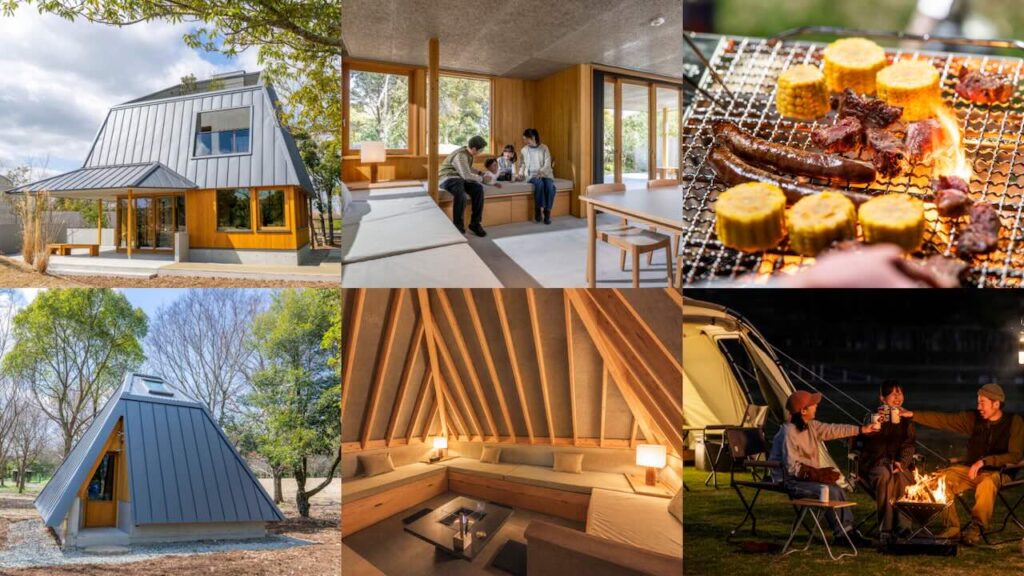
The standalone lodgings take their designs from structures at Yoshinogari. Kaze no Iori (風ノ庵), a cottage inspired by a watchtower, has a private sauna and a place to relax with views of the surrounding landscape. Hi no Iori (火ノ庵), a cabin modelled on a pit dwelling, is arranged around a fire for time outdoors. Both use ancient buildings as a starting point for contemporary places to stay.
The architecture makes sense once you have seen the park. After touring the reconstructed watchtowers and dwellings, you can spend the night in a space shaped by the same forms. Walk through the ancient village during the day, then sit around the campfire or settle into a cottage in the evening. The park now has a way to keep visitors there beyond a day of sightseeing.

Saga Craft and Food in One Place
In the retail area, the Snow Peak store stocks camping gear, clothing and products made with local partners. Alongside the usual outdoor equipment, it sells limited-edition items developed with the historical park and businesses in the area.
The complex is also home to the first permanent shop from SAGA COLLECTIVE, a collaboration among producers and businesses across Saga Prefecture. Its shelves bring together traditional crafts such as Arita porcelain and Hizen Nao washi paper, as well as Saga tea, Kanzaki sōmen noodles and sake from the prefecture. The initiative also has a policy aimed at making the carbon dioxide emissions associated with production effectively net zero.
Arita porcelain is one of Saga’s best-known crafts and holds an important place in the history of Japanese ceramics. The town has long supplied ceramics both within Japan and abroad. Hizen Nao washi is a traditional handmade paper produced using techniques passed down locally. Kanzaki sōmen comes from a long tradition of noodle-making in eastern Saga. Seen together, these products offer a way into the different industries and traditions of the prefecture.
The dining options include Starbucks Coffee Yoshinogari Historical Park and Mitsuse Dori Honpo GROUNDS Yoshinogari. Mitsuse chicken is a Saga-born regional brand and part of the prefecture’s food culture. Visitors can stop for a meal or a break without leaving the grounds. For people who came to camp, it is an easy introduction to Saga’s food and local products.
The complex also has a library devoted to the relationship between history, Saga and outdoor life. A book curator selected the titles, which range from the history of Yoshinogari and Kanzaki to the culture and landscapes of the prefecture. You can follow up on something you saw in the park or read about the area while you have time during an overnight stay.
The Fūdo Zukan programme encourages visitors to explore farther afield. Its cards introduce the park, nearby sights, the landscape and Saga’s culture. As you visit the places described, you can collect cards and assemble them into a guide of your own. The format gives visitors a reason to venture beyond the park into Yoshinogari and Kanzaki.
About an Hour from Fukuoka
Eastern Saga makes a practical addition to an itinerary covering Fukuoka and Saga City. The park is about an hour by car from central Fukuoka, and there are archaeological sites, landscapes and regional food to explore around Yoshinogari and Kanzaki. Travellers coming from Korea can also check direct flights from Incheon to Kyushu Saga International Airport. Flight schedules and local transport are worth checking for your dates.
Yoshinogari has archaeological sites, local food and outdoor activities. Neighbouring Kanzaki has landscapes and historical sites of its own. With the park spanning both communities, they fit readily into one itinerary. You can see the main site in a day or use the campsite and lodgings as a base to give the surrounding area more time.
For repeat visitors to Fukuoka, this part of Saga is another way to spend time in Kyushu. Beyond the city’s shopping streets, there are the traces of ancient settlements, a place to camp, and local crafts and food to discover. Other stops in Saga can be added around a visit to the park.
At Snow Peak GROUNDS YOSHINOGARI, an outdoor company has built around a piece of local history. A park centred on a 2,000-year-old Yayoi settlement now offers camping, overnight stays, shops, food and a reason to explore its neighbouring towns. You can still come for the reconstructed village and its workshops, or stay outdoors and get to know a little more of Saga.
For an itinerary that pairs an archaeological site with a night outdoors, or a trip beyond Fukuoka to a smaller town, Yoshinogari Historical Park and Snow Peak GROUNDS YOSHINOGARI fit together.
Snow Peak GROUNDS YOSHINOGARI — Visitor Information
- Location
- Yoshinogari Historical Park, Saga Prefecture, Japan
- Opened
- March 18, 2026
- Facilities
- Campground, cottages, cabins, sauna, Snow Peak store, SAGA COLLECTIVE, dining and a library
- Website
- Official Snow Peak site
- Park information
- Yoshinogari Historical Park
- Official Instagram
- Saga Prefecture × Snow Peak