 WALKSCAPE
 Crosswave Edition
Why Starbucks Korea’s ‘Tank Day’ Was More Than a Marketing Mistake
2026-05-20
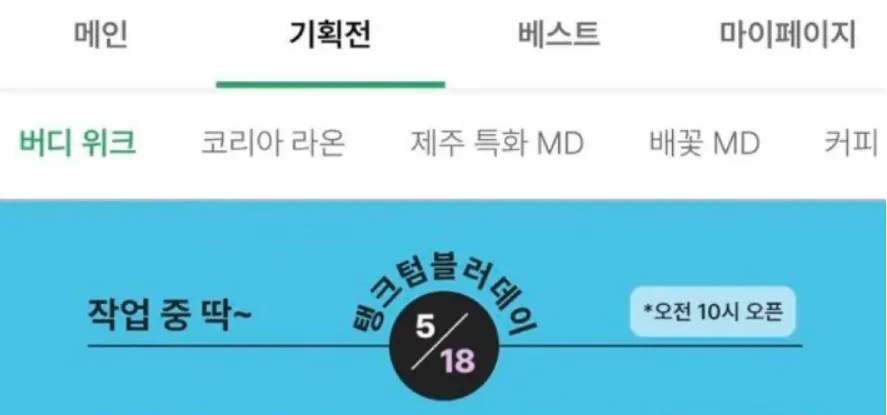
On May 18, 2026, Starbucks Korea shook years of work on its public image with one promotion. ‘Tank Day’ looked, on the surface, like a sale for a tumbler. It drew fierce criticism online as soon as it appeared.
The objection went beyond the word ‘tank.’ There was the date, May 18, the name ‘Tank Day,’ and the line chaeksang-e tak, which evokes a sharp tap on a desk. Each element could be explained away in isolation. Together, they called up specific historical memories, and many people did not see the combination as an ordinary mistake.
The May 18 Gwangju Democratization Movement carries an enduring significance in South Korea. It touches on state violence, democracy, sacrifice and public memory. It remains a sensitive part of the country’s modern history. Seeing a large global brand use the words ‘Tank Day’ on that particular date was a shock for many people.
A company of Starbucks’ size ought to have a way to catch such risks before a campaign goes live.
How the Campaign Passed Review
One of the first questions people asked was simple.
“Did they really not know?”
We cannot establish intent. For a company managing a crisis, the more useful question is how the campaign came to look the way it did. A national promotion does not usually go live on impulse, the way a personal social media post might. It normally passes through several rounds of review.
A staff member drafts it, a team lead reviews it, a design team prepares the materials, and the brand and operations teams make their final checks. Sometimes legal review follows. A nationwide promotion by a large chain is an especially likely candidate for this kind of process.
Yet ‘5/18,’ ‘Tank Day’ and the desk-tapping phrase all made it through to publication together. The failure is difficult to explain as one employee’s mistake. It suggests that the organization as a whole had no effective check for how the wording would land.
Companies often try to close an incident by blaming an individual employee’s inattention. The more troubling question for customers is whether anyone inside the company thought something was wrong.
Starbucks is a global company that has put social responsibility at the center of its public identity. It promotes environmental campaigns, diversity, local communities and ethical consumption. Missing one of the most sensitive associations in modern Korean history left an impression that its stated values and its internal practices were far apart.

The History Behind a Tap on the Desk
One of the phrases that drew the strongest response was chaeksang-e tak. On its own it can sound like an ordinary sound effect. To someone familiar with modern Korean history, it carries a much more specific weight.
The wording recalls the death of Park Jong-chul under torture in 1987.
Park was a Seoul National University student. He died after being beaten and water-tortured during questioning at a police anti-communist investigation office in Namyeong-dong. The military government tried to play down and conceal what happened. Investigators initially put out an account to the effect that they had struck the desk and Park had cried out and died, an attempt to deny the torture.
The line went on to symbolize state violence and the lies used to cover it up.
When the truth emerged, it sent shock waves through South Korea. Park’s death became one of the events that galvanized the June Democracy Movement of 1987. Its significance extends far beyond the circumstances of the investigation.
That history gives a phrase about a sharp tap on a desk a sensitivity that is easy to miss outside Korea. Seeing it on the anniversary of May 18 made the overlap particularly hard for many people to put down to coincidence.
Whether anyone at Starbucks intended those associations remains unconfirmed. A global brand still has to contend with the memories its campaign evokes.
In a society where the wounds of recent history are still felt, even a few words can have an emotional impact well beyond their literal meaning. The campaign came to be seen as evidence of weak historical and social judgment inside the company.
Companies’ Reliance on Meme Marketing
The episode reflects a wider pattern. For years, Korean companies have leaned on online vernacular and meme culture in their advertising.
Corporate advertising once favored more carefully polished language. Social media shifted the style. Companies borrowed the expressions of online communities and adopted popular memes to sound closer to younger customers.
At first it worked. A formal brand could suddenly feel approachable, and people responded to a company that seemed to understand how they spoke. Over time, some campaigns began to cross lines they had not thought through.
A meme can look like a harmless joke on the surface and still come from a context of political mockery, hate speech or contempt for a particular group. In South Korea, memes have long circulated between ordinary internet culture and more extreme political communities. Borrowing one without knowing where it came from can provoke a backlash.
Companies have nevertheless become more willing to do whatever will spread. Views, attention and shares turn into the key measures of success, and a provocative line can win out over a more considered one.
Starbucks’ campaign makes more sense in that context. It was part of a wider corporate appetite for borrowing the sound and attitude of internet memes.
Once an audience associates a brand with a political code, the company cannot simply take that association back. People are particularly unlikely to see the joke as harmless when it recalls state violence or the struggle for democracy.
The First Response Made It Worse
Companies in a crisis often draw more criticism for how they respond than for the initial error. Starbucks was no exception.
Starbucks did not withdraw the promotion immediately. It revised the copy, changing ‘Tank Day’ to ‘Tank Tumbler Day’ and replacing the desk-tapping phrase.
The revision made matters worse. Customers could take it as a sign that the company still did not understand their objection. Replacing a few words could do little to erase the historical association that had already formed.
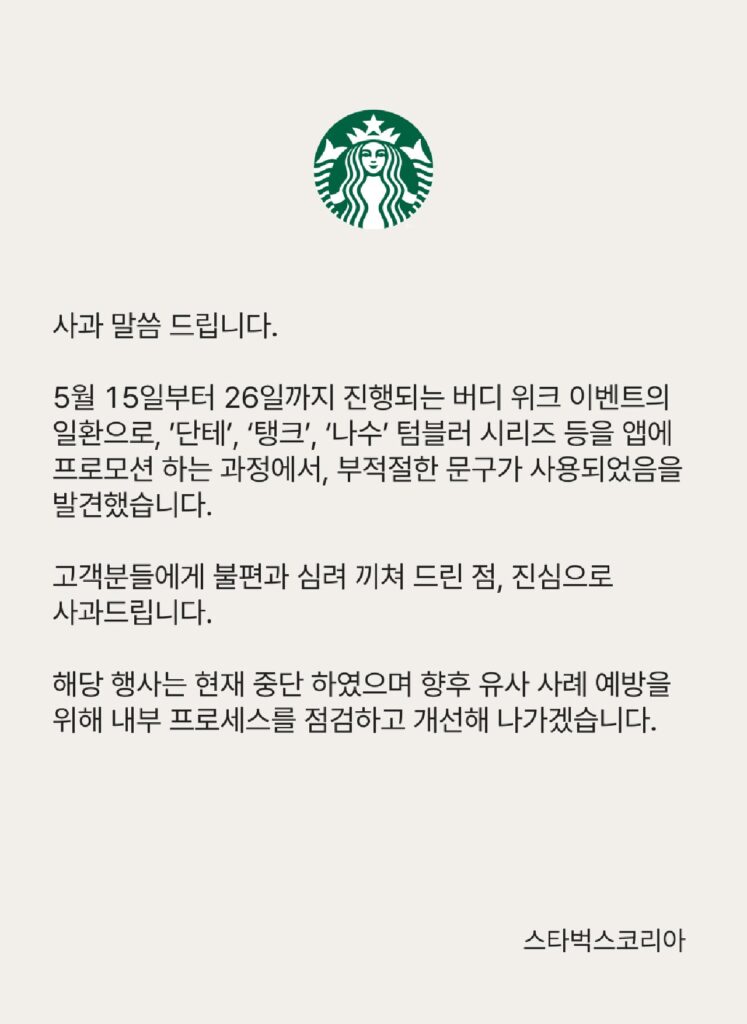
A quick patch can be a risky response when the underlying problem has yet to be understood. In this case, even the revised language was read in connection with another online meme and drew further criticism. Starbucks eventually stopped the promotion, issued a formal apology and removed its chief executive in Korea.
Starbucks’ US headquarters also issued an apology. Its unusually direct involvement in a local marketing dispute suggests it saw the incident as a risk to the wider brand.
Why the Companies Moved So Quickly
The episode renewed interest in the contract between Starbucks Korea and the US company. Industry discussion returned to a reported call option included when Shinsegae Group acquired its stake in the Korean operation. Accounts of the provision suggest the US company could take back shares under certain circumstances, including damage to the brand.
The terms have not been made public. What matters here is that the Korean business operates within a system for managing a global brand.
The US company has a clear interest in protecting that brand. A dispute tied to politics or history in one market can reach other markets and affect the company as a whole. AFP, Reuters and The Guardian were among the international outlets that covered the incident, carrying it beyond South Korea.
Shinsegae also faced pressure. With large retail developments underway in Gwangju, a controversy related to May 18 risked putting it at odds with the community. The speed of the apology and removal of the executive could reflect several pressures at once: the brand, the global contract, regional business and politics.
What Customers Saw in the Brand’s Attitude
The public response involved disappointment as much as anger. Starbucks had long presented its stores as places to take part in a culture, with messages about taste, atmosphere and values shaping the way it sold coffee. It had also made social messages part of its identity.
The campaign showed how quickly that identity could come apart. Customers notice a brand’s attitude alongside what it sells. They see the values it claims, how it regards the society around it, and how it handles historical memory. That is why the episode looked like a failure of the brand’s philosophy as well as a failed promotion.
Historical Memory Belongs in the Review Process
Companies often talk about political neutrality. Historical tragedy and the struggle for democracy call for a basic awareness of what people remember.
South Korea’s modern history is still lived memory. The May 18 movement remains part of the lives of survivors, bereaved families and local communities.
Marketing that touches such a memory can carry consequences far beyond one unsuccessful promotion. The episode may endure as an example of what can happen when companies depend too heavily on internet memes and the chase for viral attention.
Looking current and exercising good judgment about a brand are two different skills.