 WALKSCAPE
 Crosswave Edition
An Atlas of Major League Baseball, One Ballpark at a Time
2025-12-26
How a ballpark shapes the game and the city around it
A century of box scores will tell you who won, who pitched and who hit the home run. To understand what makes Major League Baseball distinctive, it helps to ask where those games happened and what each club built there.
Across the United States and into Canada, clubs have made homes in dense neighborhoods, at the edge of downtown and on big sites set apart from the street. Each ballpark holds something of the city around it. Put them all on a map and you can read it as a picture of baseball and of the places that took to the game.
Two leagues before there was one MLB
How the American and National leagues grew together
Major League Baseball looks like a single competition today. Teams play under a common rulebook and chase the same World Series title. It began with separate leagues, and that history explains why so many cities and fan bases still talk about which league they belong to.
The National League dates to 1876. The American League became a major league in 1901. Their champions met in the first modern World Series in 1903, beginning a rivalry that survived long after the leagues agreed to share the stage.
The two leagues once had separate presidents and umpiring crews. Even clubs in the same city could spend the regular season following entirely different opponents. A New York fan could know the Yankees’ schedule by heart and hardly see the Mets on it before interleague play arrived in 1997.
For several decades, you could often tell which rules were in effect by looking at the lineup. Was the pitcher due up to hit? The answer used to depend on the league.
The American League introduced the designated hitter in 1973. A designated hitter bats in place of the pitcher, allowing the pitcher to stay in the game without taking a turn at the plate.
The National League kept pitchers in the batting order in ordinary league play for much longer. A manager deciding whether to pinch-hit for a pitcher was often making two decisions at once: how to get a run now and who would take the mound next.
Both leagues used the designated hitter in the shortened 2020 season, and MLB made it a permanent rule in both leagues in 2022. The change removed a familiar tactical distinction. The names on the outfield walls, and the dimensions of the walls themselves, stayed as varied as ever.
You can find parks that favor hitters and parks that favor pitchers in both leagues. A steep outfield wall, a deep gap, a roof or thin air at elevation tells you more about a ballpark than the league initials next to its home team.
League history still matters. Some of the same teams have played one another for more than a century, even as parks have opened and closed and clubs have moved between cities or leagues.
To see what survived from that history, start with a club’s home field. Even if the name has changed, the walk to the gate and the view from behind home plate can tell you where you are.
Why divisions exist
East, Central and West
The league names tell you something about where MLB came from. The divisions tell you who a team keeps running into on the schedule and who it has to beat for a division title.
Crossing the continent means several hours in the air and, often, several time zones. Grouping teams roughly by geography helps make a long season possible, even if a division name cannot make every trip short.
Repetition builds rivalries. MLB’s more balanced 2023 schedule reduced the number of games against each division opponent to 13, still enough for a series in April to matter when the teams meet again late in the season.
Divisions put contrasting parks on the same itinerary. An AL East road trip might take a club from Boston’s open-air Fenway Park to the retractable roof of Toronto’s Rogers Centre. The NL West pairs a park beside San Francisco Bay with another roughly a mile above sea level in Denver.
Those conditions are part of the game. Hitters and fielders have to learn how the ball carries, how a fence plays and how much room they have to chase a fly. The differences are easiest to notice when you follow one team across a series of parks.
Geography makes the schedule workable. Over time, the trips and rematches give each division its own history.
Why every park is different
A common rulebook leaves room for local quirks
The game is recognizably the same from park to park. The surprise is how quickly the view changes beyond the infield. Fences turn corners, walls rise or fall, and the distance to the seats can change sharply from one stretch of the outfield to the next.
The rules establish common dimensions for the infield and leave room for different outfield shapes. Each ballpark also has ground rules for its particular features, from railings to scoreboards. A design choice can therefore become an umpire’s decision.
A fly ball that clears one wall can die on another park’s warning track. Distance matters, but so do wall height, temperature, wind and elevation. A ball that stays in the yard might still take an unfamiliar bounce and turn a single into a double.
Statcast park factors give us a way to look past a single home run or a windy afternoon. They compare how often outcomes happen in one park with how often they happen elsewhere, while accounting for who played there.
The dimensions are worth knowing before first pitch. Then you can watch how the outfielders shade a hitter, and why a ball that looks routine on television might give the home crowd a reason to get up.
Why look at a map?
What the ballpark tells you about its city
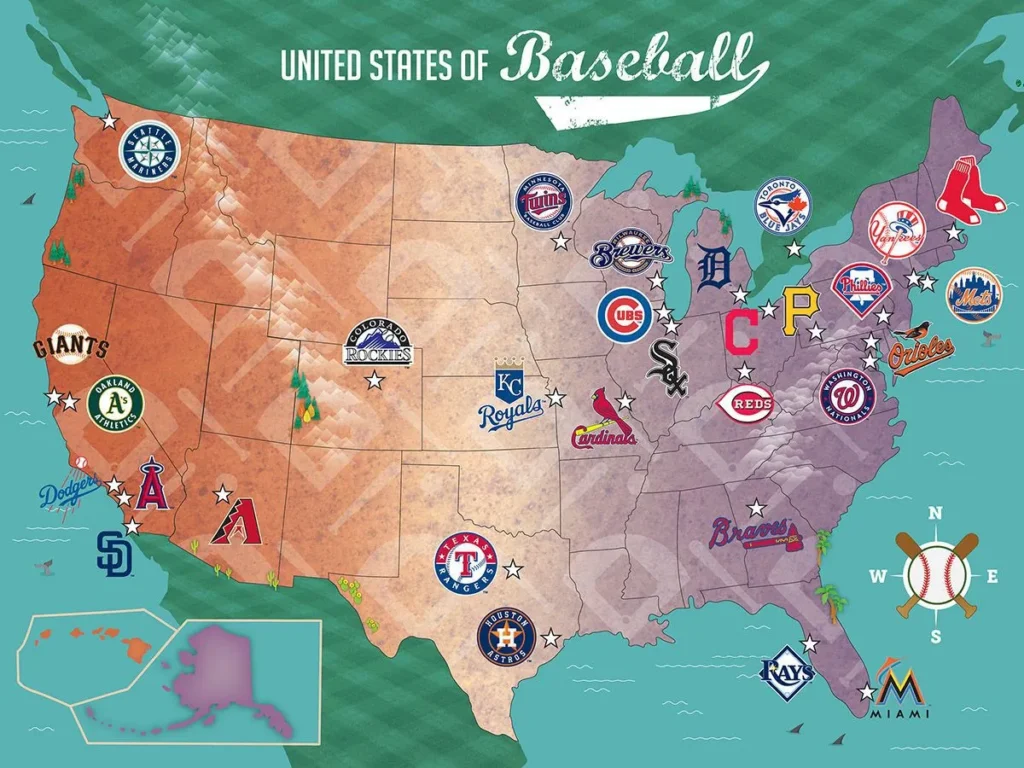
Spread the parks out on a map and look at where they sit. A few are tucked into an older street grid. Others are surrounded by parking or built into a larger development. The address can tell you almost as much as the outfield view.
Ballparks offer glimpses of how cities have grown. Some clubs inherited compact sites from an earlier age. Others built alongside rail corridors, waterfronts or expressways, depending on how fans were expected to arrive.
Compare the routes spectators take before and after a game. A short walk past restaurants is a different experience from a drive out of a stadium lot. The map below is useful as a historical snapshot. For current home parks and names, see MLB’s ballpark directory.
National League
From neighborhood landmarks to parks that face the water
NL East
The NL East takes in two clubs with nineteenth-century roots, the Braves and Phillies, as well as newer franchises. Its parks stretch from New York to South Florida, which leaves plenty of room for different ways to spend an afternoon at the ballgame.
- Atlanta Braves — Truist Park
- Washington Nationals — Nationals Park
- Philadelphia Phillies — Citizens Bank Park
- New York Mets — Citi Field
- Miami Marlins — loanDepot park
Citi Field sits in Queens beside the site of Shea Stadium. The Marlins’ ballpark occupies the former Orange Bowl site in Miami. Both parks inherit a local sporting geography, even though the old venues are gone.
NL Central
The NL Central makes a good case for looking beyond a park’s age. Wrigley Field’s brick and ivy have been familiar for decades. The view from PNC Park across the Allegheny River is a much newer fixture in Pittsburgh.
- Milwaukee Brewers — American Family Field
- Chicago Cubs — Wrigley Field
- St. Louis Cardinals — Busch Stadium
- Pittsburgh Pirates — PNC Park
- Cincinnati Reds — Great American Ball Park
In Chicago, the ballpark is part of a neighborhood. In St. Louis and Cincinnati, downtown skylines help frame the game. Each park offers a different answer to the question of where baseball fits into city life.
NL West
The NL West puts the region’s climate and landscape in the foreground. Chase Field has a retractable roof in Phoenix. Coors Field plays outdoors in Denver, where altitude changes how the ball moves.
- Los Angeles Dodgers — UNIQLO Field at Dodger Stadium
- Colorado Rockies — Coors Field
- Arizona Diamondbacks — Chase Field
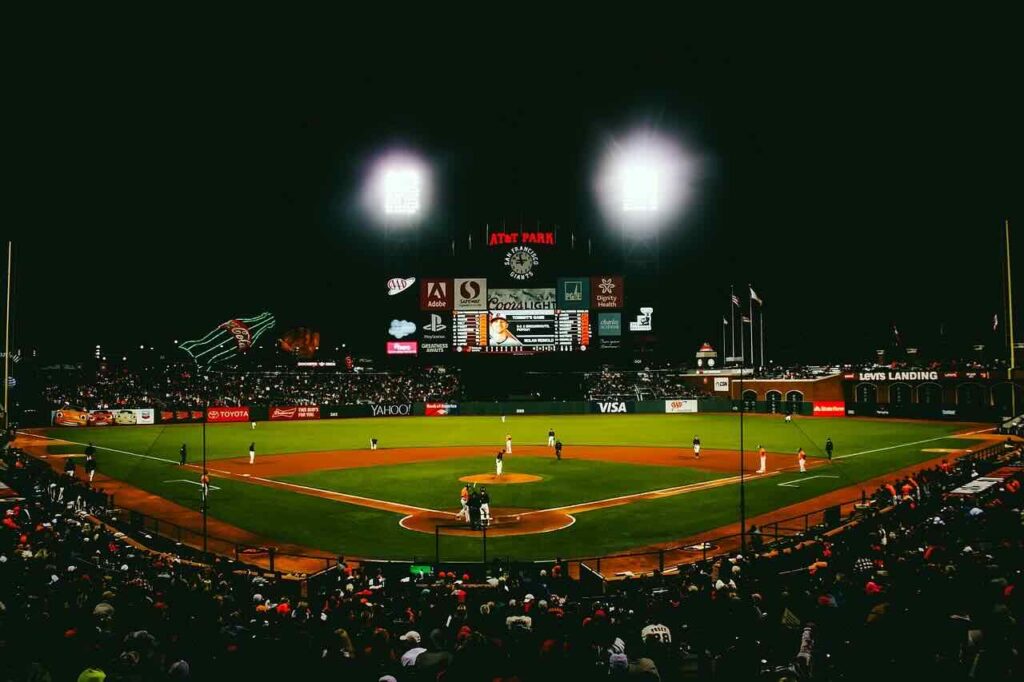
- San Francisco Giants — Oracle Park
- San Diego Padres — Petco Park
In San Francisco, home runs to right can land in McCovey Cove. In Los Angeles, the hills beyond Dodger Stadium help place you before a pitch is thrown. Few divisions offer this much variety between consecutive stops.
American League
Old rivalries and newer addresses
AL East
Yankees–Red Sox is the fixture many fans know first. The whole division, however, runs from an old Boston neighborhood to downtown Toronto and across Florida’s Tampa Bay area.
- Boston Red Sox — Fenway Park
- New York Yankees — Yankee Stadium
- Tampa Bay Rays — Tropicana Field
- Toronto Blue Jays — Rogers Centre
- Baltimore Orioles — Oriole Park at Camden Yards
Fenway Park shows what a club can do with a tight site. Camden Yards shows how a newer park can borrow the scale and materials of older ones. Both have influenced how fans think a major-league park ought to feel.
AL Central
The AL Central takes in Great Lakes cities and stretches west to Minnesota and Missouri. The parks include downtown fields and a larger stadium complex with a very different approach to getting to the game.
- Cleveland Guardians — Progressive Field
- Minnesota Twins — Target Field
- Detroit Tigers — Comerica Park
- Chicago White Sox — Rate Field
- Kansas City Royals — Kauffman Stadium
AL West
The AL West spans three time zones, from Texas to the Pacific Coast. One address is temporary: the Athletics are playing in West Sacramento ahead of their planned move to Las Vegas.
- Texas Rangers — Globe Life Field
- Houston Astros — Daikin Park
- Athletics — Sutter Health Park, West Sacramento
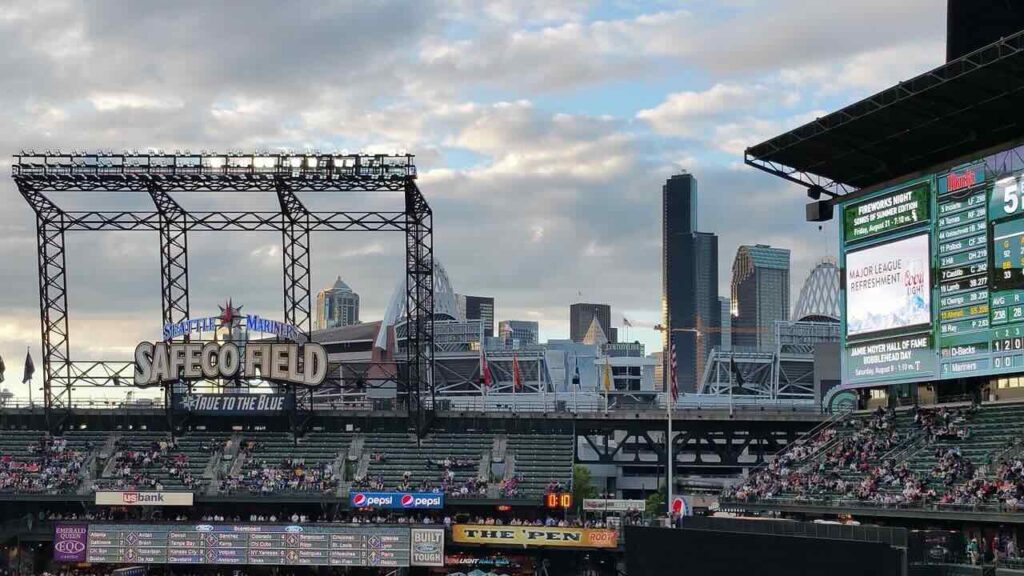
- Seattle Mariners — T-Mobile Park
- Los Angeles Angels — Angel Stadium
To understand MLB, look at its parks
Watch enough games in different parks and the same thought keeps returning.
The ballpark completes the game.
Lineups turn over and records fall. A ballpark can hold on to a view, a route to the seats or a peculiarity in the fence for generations. Long after a player retires, someone else will have to play the same rebound off the wall.
Even a replacement stadium carries some of that history. The next site changes how people get to a game and what they see once they arrive. The crowd brings its habits and memories along.
Start with one place on the map. How far is the park from downtown? What was on the site before it opened? Which way does the outfield face? The answers can tell you as much about the city’s choices as they do about baseball.
Then look at a game there. Watch what happens to a deep fly, where the crowd moves between innings and what you can see over the fence. Those details rarely survive in the final score.
A map is a good way in, especially if you follow MLB from far away. Pick two parks a club visits in the same week and see how much the game changes around it.
Soon the team names bring places to mind. That is when the map starts to feel like an atlas of baseball.